Affordable Tree Service Near Me: 6 Ways to Save in Florida
The best affordable tree service near me is a licensed, insured local crew that inspects your tree, quotes in writing, and removes only what has to go. If you are unsure whether a tree is worth saving, start with a certified arborist. If you have several jobs, compare three written estimates. If a storm did the damage, check your insurance first .
The trouble is that the lowest number on a bid rarely stays the lowest. Uninsured crews, vague scopes, and removals that pruning would have solved turn a cheap quote into an expensive mistake. In North Port, Port Charlotte, and Venice, storm season adds another twist, because demand and prices jump when branches start coming down.
Below are six ways to pay less for tree work without gambling on quality. Each one covers how it works, what it saves, and who it fits. We are a family-owned tree company in North Port, so the advice comes from the work we do on local properties.
1. Hire an arborist who diagnoses before cutting
How it works
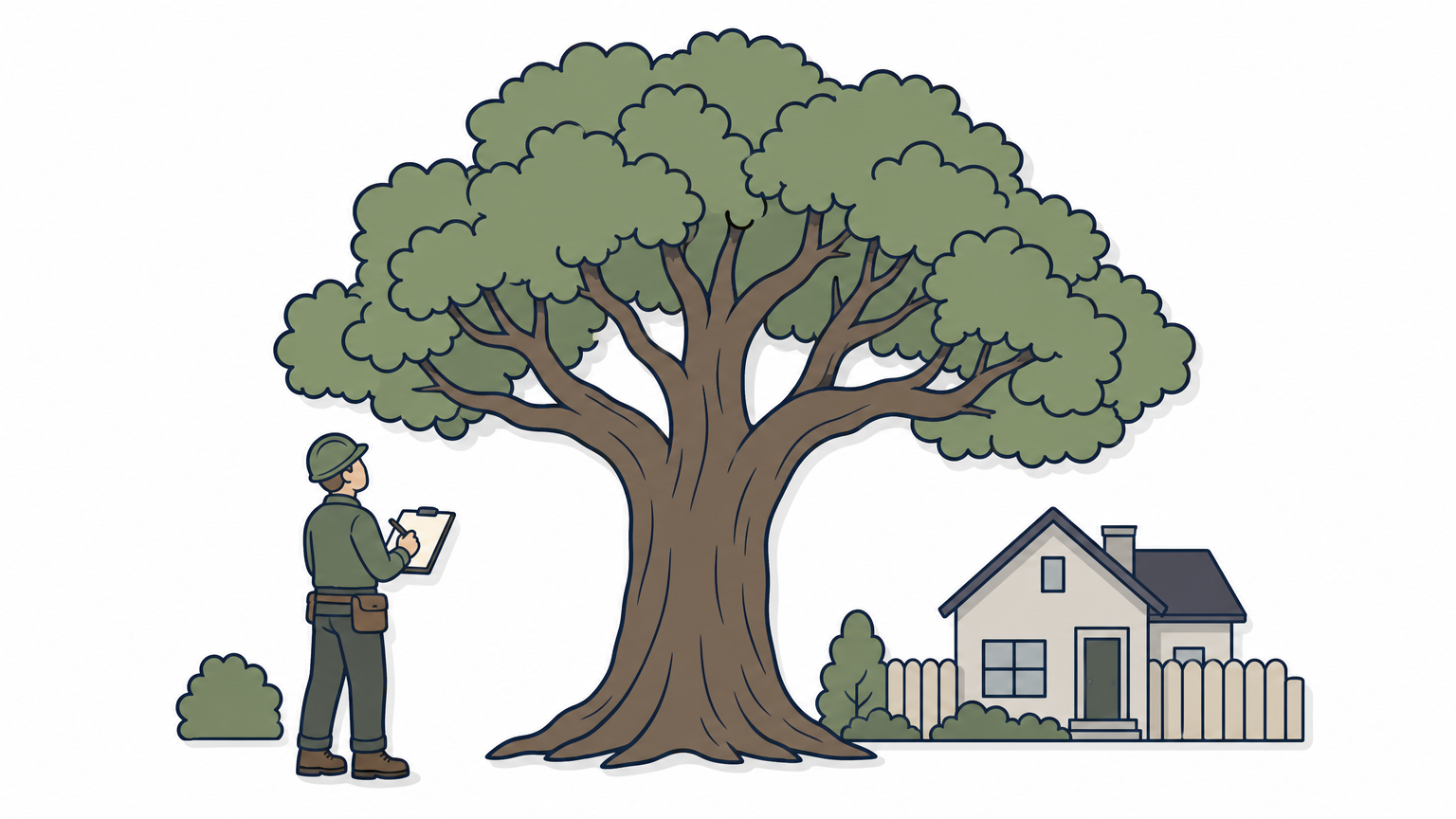
A certified arborist looks at the whole tree before anyone picks up a saw. At ArboBella Tree Service, an ISA Certified Arborist (FL-295224A) evaluates each tree's health, structure, location, and surrounding conditions , then recommends pruning, treatment, or removal. The aim is to keep healthy trees whenever practical , so you pay for removal only when a tree is dead, declining, damaged, or hazardous. The same team handles the jobs that follow:
- Arborist diagnosis for declining or damaged trees
- Trimming and pruning for structure and clearance around roofs and driveways
- Tree removal, planned around homes, fences, and landscaping
- Stump grinding for stumps left in lawns
The cheapest removal is the one a diagnosis shows you do not need.
Savings and who it suits
Removal is usually the biggest line on a tree bill, so avoiding an unnecessary one saves the most. A tree with a weak limb or a crowded canopy often needs targeted pruning instead. Pricing depends on the tree and the site, so ask for a quote on your property and a written reason for each cut.
This option suits homeowners in North Port, Port Charlotte, and Venice who cannot tell whether a tree is salvageable. ArboBella is licensed, insured, and has more than 10 years of industry experience. Call 941-932-1768 or email info@arbobellatreeservice.com to ask about your trees.
2. Compare three written estimates nearby
How it works
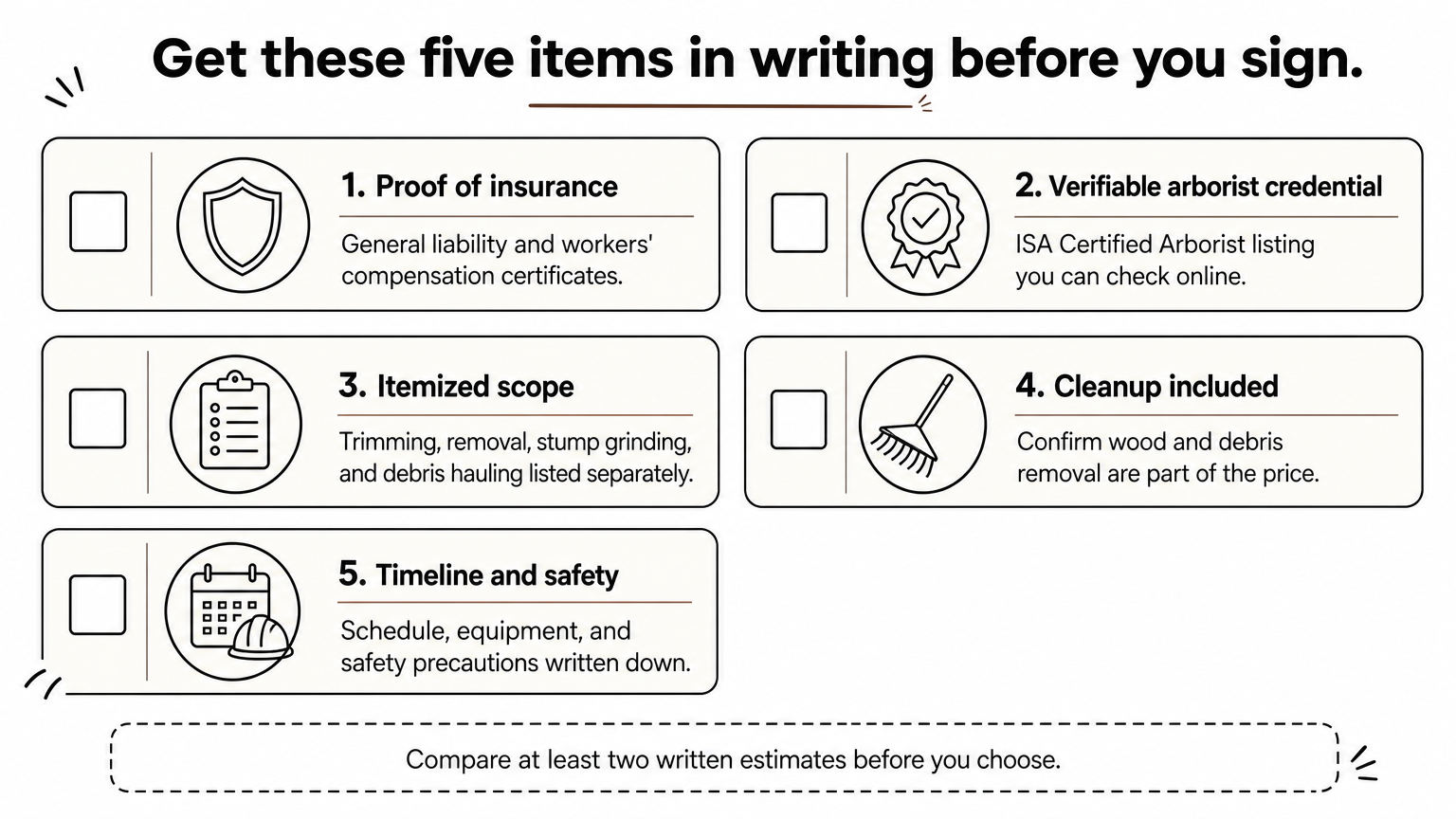
Request written estimates from at least three licensed, insured companies before you sign anything. Stay local, because crews that work your area daily, roughly within 20 miles of your home, drive less and are easier to vet before you hire. Many companies offer a free estimate , but confirm that when you call, because policies differ. Ask each one to put these items in writing:
- Proof of general liability and workers' compensation insurance
- An ISA Certified Arborist credential that you can verify on the ISA website
- An itemized scope covering trimming, removal, stump grinding, and debris hauling
- Whether cleanup and wood removal are included
- Timeline, equipment, and safety precautions
Savings and who it suits
Price context helps you spot an outlier. Thumbtack's national data gives these typical ranges:
| Job | Typical national range | What raises the price |
|---|---|---|
| Tree trimming | $436 to $1,221 | Height, access, power lines |
| Tree removal | $722 to $2,068 | Size, health, equipment, cleanup |
As a worked example, one tree trimmed and one tree removed lands between $1,158 and $3,289 combined. Florida quotes, especially on removal pricing, can fall outside these ranges, so use them to flag outliers, not as a price list. A bid far below the others usually means no insurance, no cleanup, or a vague scope .
Compare totals line by line, never the headline number.
This tactic suits anyone with several jobs, a large tree, or no feel for local prices. It is also the honest answer if you search for the cheapest tree service near you: the lowest insured bid with cleanup included wins, not the lowest number on the page.
3. Time the work and bundle jobs
How it works
Book non-urgent work before demand spikes. Atlantic hurricane season runs from June 1 to November 30, and crews fill up fast after storms, when urgent jobs typically carry a premium . Nationally, winter is a slower period for tree services, so ask local crews which weeks are quiet. Then combine work to cut the number of visits:
- Trim weak or overextended limbs before storm season, not after
- Pair trimming, removal, and stump grinding in one visit
- Ask neighbors to book the same crew on the same day
A scheduled job typically costs less than the same job after a storm.
Savings and who it suits
Bundling gives a crew one setup instead of several, so asking for a package price is reasonable. Some companies discount multiple jobs on the same street, but none is guaranteed, so ask while you collect estimates. The savings come from fewer trips and a predictable schedule.
This route fits homeowners whose trees are healthy but overdue, and HOAs and property managers with several properties to maintain. It does not fit a tree that is already leaning, cracked, or hanging. That tree needs emergency tree help today, not a better season.
4. Choose the lightest cut that solves the problem
How it works
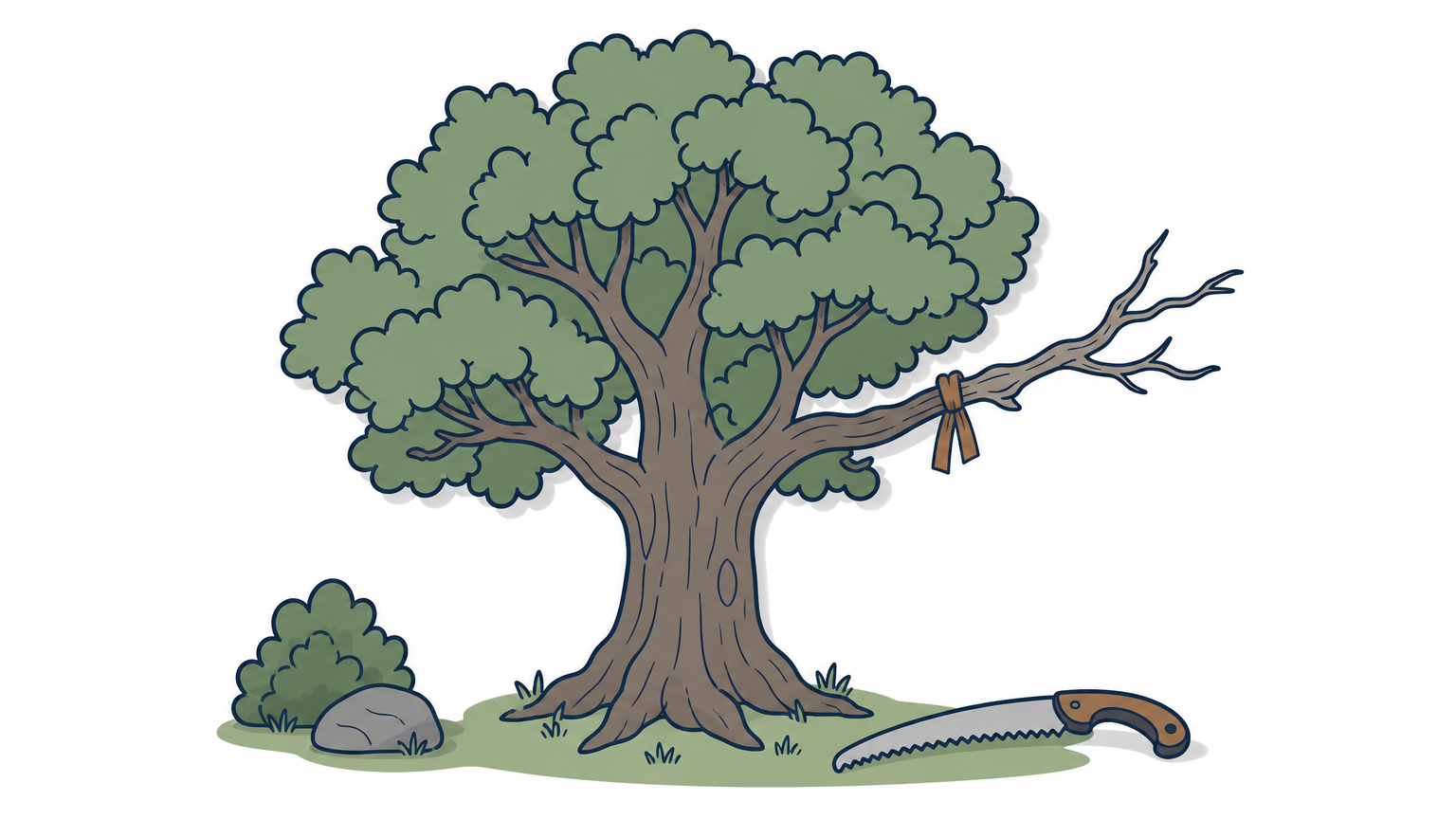
Cheap tree cutting starts with matching the job to the problem. Trimming usually costs less than removal, and stump grinding is optional . Use this table to decide what to ask for:
| Option | Use it when | Worth knowing |
|---|---|---|
| Trimming and pruning | Dead, crossing, or poorly positioned branches, or you need roof or driveway clearance | Often enough for a healthy tree |
| Tree removal | The tree is dead, declining, damaged, or hazardous | Planned around nearby structures |
| Stump grinding | A stump in the lawn is in your way | Grinding does not generally excavate the root system |
Ask for the smallest job that makes the tree safe, then add from there.
Savings and who it suits
You can trim the bill further by taking over the low-skill parts. Some companies charge extra to haul branches and logs, so offer to handle ground cleanup yourself and keep the wood for firewood. Hardwood may even have resale value. Leave all cutting, climbing, and anything near power lines to professionals.
Budget-conscious owners with healthy trees and a free weekend benefit most. If a stump sits out of the way, decide whether it needs to go at all. Skipping the grinder for now is a legitimate way to save .
5. Prevent storm damage with a risk program
How it works
A tree risk program finds the weak tree before the storm does. ArboBella's Homeowner Tree Risk Mitigation Program has ISA Certified Arborists identify potentially hazardous trees , carry out the recommended risk-reduction work, and provide documentation you can give your insurance agent for review. An ISA Certified Arborist then conducts a final inspection once the work is done.
The Annual Tree Risk Protection Service builds on that. You keep ongoing documentation of your property's tree conditions and receive preventive recommendations as trees and risks change. Annual customers also receive priority consideration for qualifying preventive work and storm-related services, subject to availability.
Fixing a weak tree on your schedule beats paying emergency rates on the storm's.
Savings and who it suits
Planned risk work costs less than emergency response, because urgent calls typically carry a premium and a fallen tree can damage a roof or fence. We do not promise an insurance discount, premium reduction, or coverage approval from this documentation. That decision belongs to your insurer, so talk to your agent before you expect savings there.
These programs fit homeowners with large trees near the house , especially in Southwest Florida, where storm season is a yearly fact. If you want a one-time answer instead, a diagnosis from the first option is the cheaper place to start.
6. Use insurance and local help before you pay
How it works
Free tree removal usually means someone else is paying, so check the likely payers first. Three sources are worth a call:
- Your homeowner's insurance: Many policies cover removal when a tree falls on a covered structure, subject to limits and your deductible. Call your agent before hiring, and photograph the damage.
- Your electric utility: If a tree touches or leans on a power line, stay clear and call the utility. Line clearance is its job.
- Your city or county: Trees on public property or rights-of-way are the local government's responsibility. Some cities, counties, and nonprofits run help programs for seniors or low-income households, but availability varies.
There is no universal free tree removal, so ask the party that may owe you the work.
Savings and who it suits
When one of these sources covers the job, your savings equal the whole bill. When none does, you still leave with a clearer budget and paperwork for your agent. Be wary of unsolicited crews who show up after a storm and ask for cash upfront , and apply the checks from option two before accepting any help.
This path fits storm-hit homeowners and seniors on a fixed income. Make one call to your insurance agent, a second to your city or county, and keep the written estimates you collected from the other options in hand.
Pay less without gambling on quality
Affordable tree service is mostly about avoiding waste. Skip the removal a diagnosis can prevent, compare three written estimates from insured crews nearby, book before storm demand hits, and ask who else might pay. The lowest bid only wins when insurance, credentials, and cleanup are in writing.
Start with the tree that worries you most. Get a diagnosis from a certified arborist, a written scope, and a price you can compare. If you live in North Port, Port Charlotte, or Venice, you can ask ArboBella Tree Service for an estimate on your trees and bring those numbers to any other bids you collect.