Local Tree Service: How to Vet, Compare, and Hire One
To hire a local tree service you can trust, shortlist three companies near you, verify each one's arborist credentials and insurance, collect written quotes that cover the same scope, and compare the work plans before you compare prices. Most homeowners can finish that routine in a few days of calls and emails. It protects you from overpaying and from letting an uninsured crew work above your roof.
The search itself is the hard part. You will see paid ads, directory listings, Facebook group tips, and after any storm, strangers knocking on your door with a chainsaw. Quotes for the same tree can differ by hundreds of dollars, and the lowest number often leaves out cleanup, stump work, or proof of insurance. A bad hire can mean a cracked roof, a scalped lawn, or an injured worker on your property.
This guide walks you through four steps, with the questions to ask and the red flags to watch for. It is written for homeowners and property managers in North Port, Port Charlotte, and Venice, where storm season and sandy soil shape how tree work gets done. ArboBella Tree Service is a certified arborist company serving those areas.
What a good local tree service looks like
A good local tree service is a licensed, insured company led by a trained arborist that evaluates your tree first and puts its plan in writing. Knowing that standard before you call makes every later step easier.
Why local matters in Southwest Florida
Hiring close to home matters because local crews know the conditions your trees live in: sandy soil, summer storms, and a hurricane season that runs from June 1 to November 30. They also know which city and county permit rules can apply to removals, which differ from one jurisdiction to the next.
Distance affects speed too. A company within roughly 5 to 10 miles can usually reach you faster for an estimate and, more importantly, for an emergency.
Arborist or tree cutter
An ISA Certified Arborist has passed an exam covering tree biology, pruning, and safety, and must keep up continuing education to hold the credential. A tree cutter may be skilled with a saw but cannot necessarily tell a salvageable tree from a failing one.
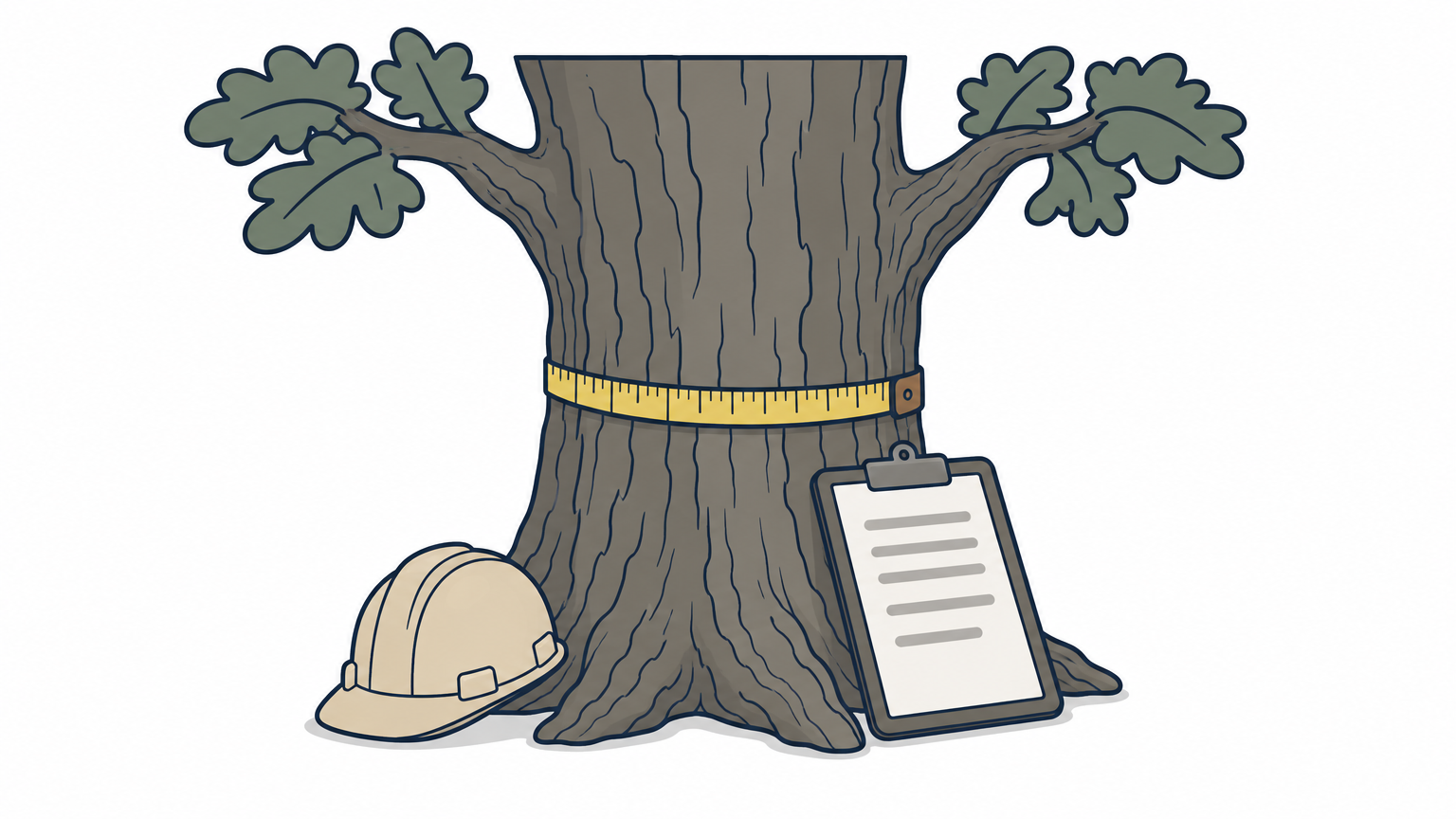
That difference shows up when a tree looks bad. An arborist checks structure, roots, and decay , and may recommend pruning or treatment where a cutter would simply quote removal.
A good tree company tells you what the tree needs before it tells you what the job costs.
Name the job before you call
Be specific when you phone, because each job is priced and staffed differently:
- Trimming and pruning: removes dead, crossing, or hazardous branches and creates clearance from roofs and driveways.
- Tree removal: for dead, declining, or hazardous trees that cannot be saved.
- Stump grinding: grinds the stump below grade, while the underground roots are generally left in place.
- Emergency work: fallen trees, hanging limbs, and split trunks.
Step 1. Build a shortlist of three companies
Build a shortlist of three local companies from at least two different sources, so that no single directory or ad decides for you. Three is enough to compare and few enough to vet properly.
Where to look
Start with Google Maps and Business Profiles , then add a neighbor's recommendation, your HOA's preferred vendors, and the ISA's online arborist directory. Chamber of Commerce membership is a small but useful trust signal, since members have a local address and a reputation to protect.
Search by your own neighborhood and keep to a radius of about 5 to 10 miles. Crews that already work near you arrive faster and price travel time lower.
How to read reviews
Read reviews for patterns, not star averages . Look for repeated mentions of showing up on time, an estimate that matched the final bill, careful protection of the house and landscaping, and a clean yard afterward.
Read the three-star reviews first, because they describe real friction without the anger. Then check for owner replies and recent photos of finished work. A flood of vague five-star reviews posted in the same week deserves suspicion.
Three well-vetted companies beat ten names you found in one search.
Step 2. Verify credentials and insurance
Verify credentials and insurance before anyone sets foot on your property, because this is the check that protects you if something goes wrong. It takes about ten minutes per company.
What to ask for
Ask each company for four things:
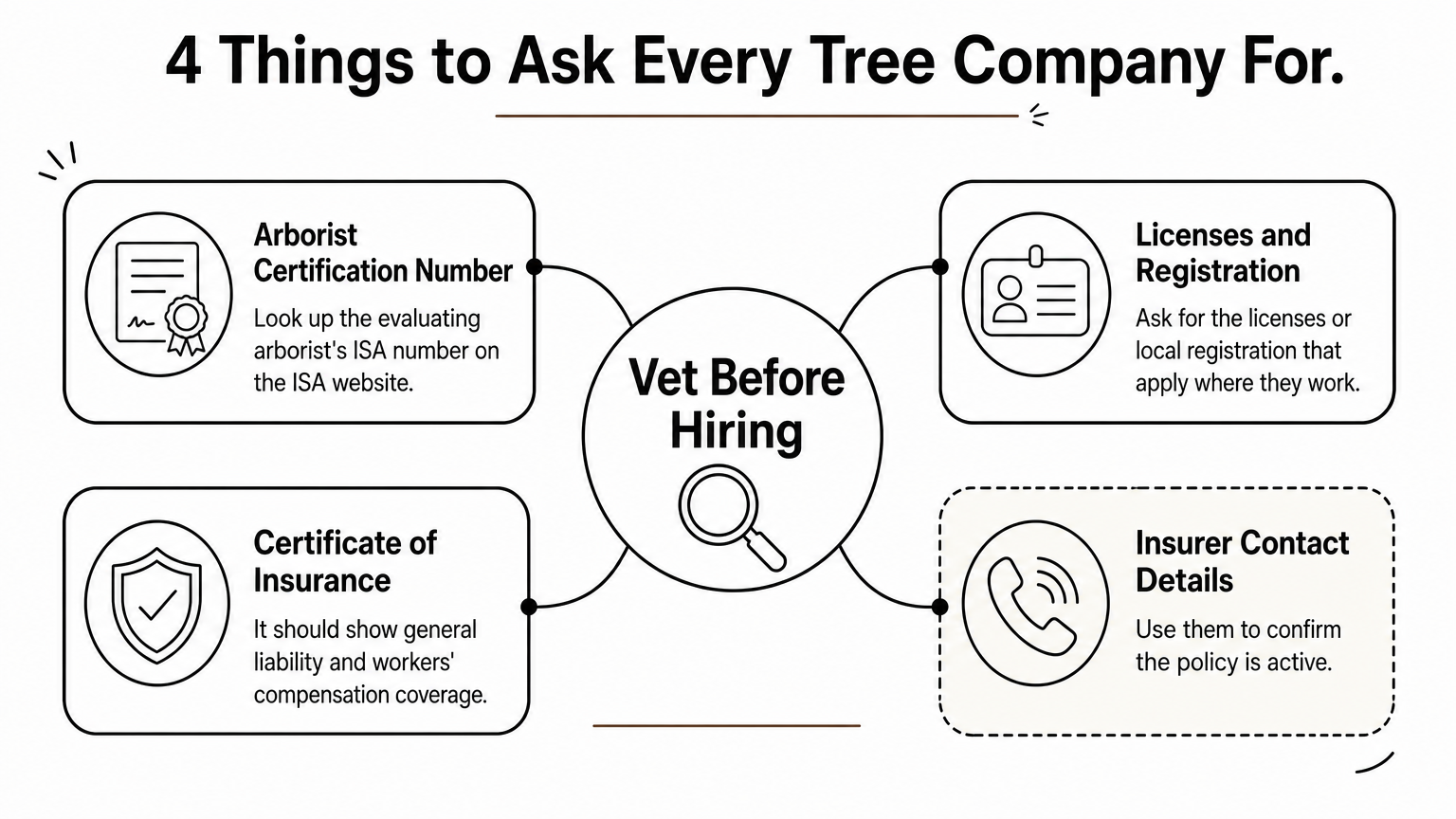
- The ISA Certified Arborist number of the person who will evaluate your tree. You can look it up on the ISA website. For example, ArboBella's lead arborist holds ISA credential FL-295224A.
- The licenses or local business registration that apply where they work.
- A certificate of insurance showing general liability and workers' compensation coverage.
- The insurer's or agent's contact details, so you can confirm the policy is active.
Request the certificate by email, and ask that it come from the insurer or agent. A company that is properly covered can send it the same day.
Red flags that end the conversation
Some warning signs are reason enough to move to the next name on your list:
- A demand for full payment upfront , especially in cash.
- No written estimate, or a price given only by text or in passing.
- A suggestion to top the tree, which means cutting main limbs back to stubs. It weakens the tree and is widely discouraged by arborists.
- Door-to-door pitches after a storm, with no local address.
- No clear answer about who carries insurance.
If a company cannot email a certificate of insurance today, it is not ready for your job.
Step 3. Get and compare written quotes
Get at least three written quotes for the same scope of work, then compare them line by line instead of by the bottom number. The cheapest quote is often the one that leaves things out.
What a fair price looks like
Published cost guides give a rough frame. Angi's figures put the average tree removal near $750, with a typical range of $200 to $2,000, and show how much height and access change the price:
| Job | Published range |
|---|---|
| Average tree removal | About $750 (range $200 to $2,000) |
| Smaller tree | As low as $8 per foot |
| Tree over 80 feet | At least $15 per foot, often $1,500 or more |
| Fallen tree cleared from near the home | $100 to $500 |
Your final price moves with access, power lines, and nearby structures . Most companies quote per job rather than per hour, so ask for the scope and a fixed total. If someone quotes hourly, ask for estimated hours and a cap.
Compare quotes line by line
Make sure every quote states whether it includes haul-away of debris, stump grinding, and permits . Here is a worked example for a 40-foot oak, with illustrative numbers:
| Quote | Removal | Haul-away | Stump grinding | Insurance proof | True total |
|---|---|---|---|---|---|
| A | $850 | Included | +$250 | Yes | $1,100 |
| B | $1,100 | Included | Included | Yes | $1,100 |
| C | $600 | +$300 | +$250 | No | $1,150 |
Company C looked $500 cheaper and ended up the most expensive, with no proof of coverage.
When to book and how to save
Prices and wait times climb after storms, so book outside storm season when you can. In Southwest Florida, winter and spring are usually calmer, and pruning before June reduces storm risk.
Free tree removal for seniors is rare from private companies. Ask your city or county, local nonprofits, or your area agency on aging about assistance, and ask each company whether it offers a senior discount.
Compare what each quote includes, and the real price becomes obvious.
Step 4. Confirm the plan and schedule the work
Choose the company that combines verified credentials, a complete written scope, and a plan you understand, then confirm that plan in writing before the crew arrives. The lowest price should only break a tie.
Get the work plan in writing
A solid work order names the date, crew size, and equipment such as a bucket truck or crane. It also explains how the crew will protect your roof, fence, and lawn, and who handles any permit. Ask what happens to the debris and the stump, and agree to pay on completion , with at most a modest deposit.
Walk the site with the crew leader on the day. Point out sprinklers, fragile landscaping, and the tree's drop zone, so nothing is a surprise.
Handle emergencies and storm damage
When a tree falls on your home or a limb hangs over it, stay clear and photograph the damage before anything moves. Call your insurance company, and call your utility if any line is involved. Never approach a tree touching power lines.
Verify an emergency crew the same way as any other, even if you do it by phone. ArboBella offers emergency service for fallen trees, hanging limbs, and split trunks. Its homeowner tree risk mitigation program ends with an ISA Certified Arborist's final inspection and documentation you can give to your insurance agent. It does not guarantee an insurance discount.
Pay for finished work, not promises.
Your next step
Finding a trustworthy local tree service comes down to four moves: shortlist three companies, verify the arborist and the insurance, compare written quotes by what they include, and lock the plan in writing before work starts. Do them in that order and you avoid most of the problems that make tree work stressful.
If you want a certified arborist to look at your tree before you commit to cutting, you can request an evaluation from ArboBella Tree Service in North Port, Port Charlotte, or Venice. Then run the quote through the same checklist you would use for any other company.