How to Hire a Removal Tree Service and Compare Estimates
The fastest way to hire a removal tree service is to collect three written, itemized estimates for the same job, compare them line by line, and choose the company that is insured, specific about cleanup, and clear about what is included. The lowest number is not the goal. Many companies quote at no charge, so you can usually finish the whole process in about a week.
The trouble is that tree removal quotes are hard to compare. One company prices by height, another by the hour, and a third leaves out the stump and the hauling. Prices vary widely from site to site. In North Port, Port Charlotte, and Venice, hurricanes put trees on roofs and fences quickly, and the crews who show up afterward are not always insured. Without a method, you end up guessing.
This guide gives you that method in four steps: confirm the tree has to come down, request estimates, compare the bids, and vet the company before you book. First, a short section covers what a removal job includes and what moves the price. ArboBella Tree Service is led by an ISA Certified Arborist, so the checklist below reflects what we see from the contractor's side of the estimate.
What a tree removal job covers and costs
A removal job covers cutting the tree down safely, cutting it into pieces, and hauling the debris away. Stump grinding and wood disposal are often priced as separate lines, so a quote that looks cheap may simply cover less. The price comes down to size, access, and risk.
What a complete quote includes
Ask every company to price these items separately. Itemized quotes are the only fair way to compare two companies, and they show you early which extras are missing .
- Felling or sectional dismantling (climbing, bucket truck, or crane)
- Cutting the trunk and limbs into pieces
- Hauling away logs and brush, or leaving the wood if you want it
- Stump grinding
- Raking and blowing the work area clean
- Permit or HOA approval checks, where they apply
Grinding takes the stump down below the surface of the lawn, but it generally does not dig out the root system. Keep that in mind if you plan to plant or build in the same spot.
What drives the price
Height, trunk diameter, and access set most of the price. A tree over a pool or beside a roof has to be lowered in sections by rope or crane, which takes more crew and more time than dropping it in an open yard. Dead or storm-damaged wood adds risk and slows the work further.
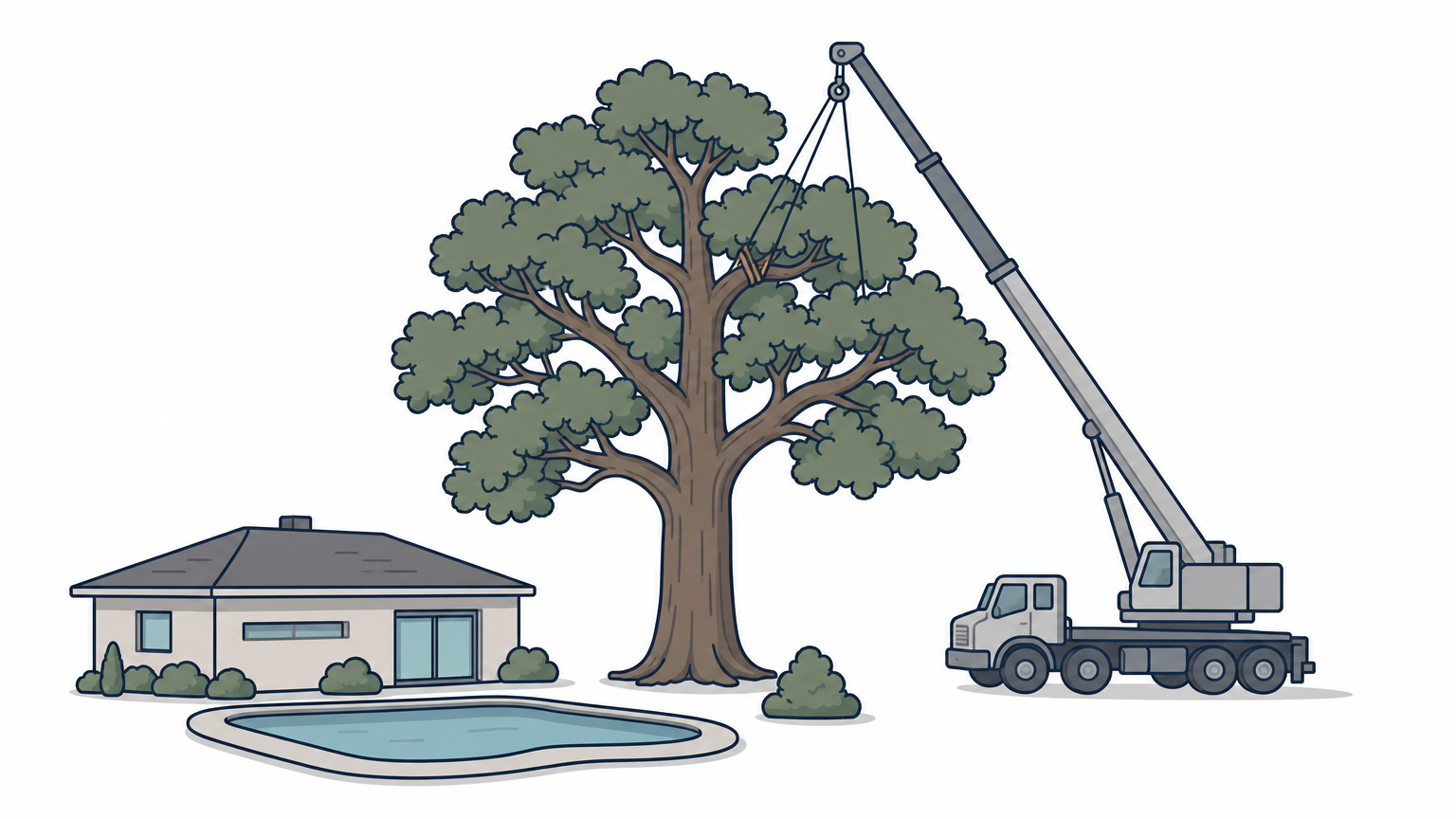
| Tree size | Typical range for a simple job | What pushes it higher |
|---|---|---|
| Small, under 30 ft | $200 to $600 | Tight access, a fence or shed nearby |
| Medium, 30 to 60 ft | $600 to $1,200 | House, pool, or power lines within reach |
| Large, over 60 ft | $1,200 to $3,000 and up | Crane, dead or unstable wood, hard access |
Treat these figures as sanity checks, not quotes. A 30-foot tree in open space sits at the low end of the middle row, and the same tree over a roof can move up a tier. A job near $1,000 usually means a tall tree or tight access.
A removal quote is only as good as its line items: if cleanup and the stump are not written down, assume they are not included.
Step 1. Confirm the tree has to come down
Removal is the right call when a tree is dead, structurally failing, or too close to a structure to fix with pruning. For anything else, get an arborist's opinion first, because pruning or treatment can cost far less than removal.
Check for warning signs
Walk around the tree in daylight and look for these signs. Two or more is a reason to call someone this week.
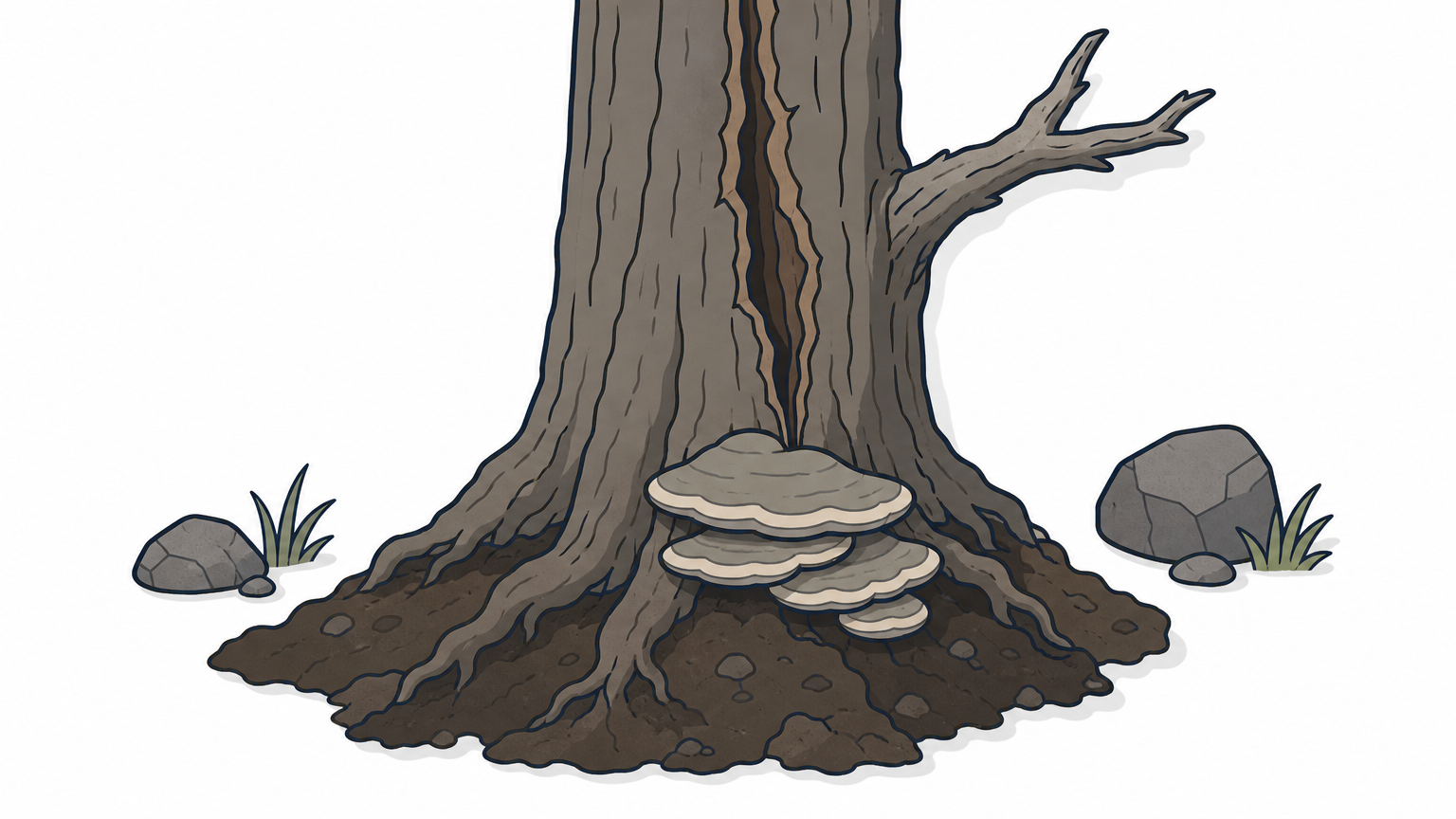
- A canopy that is mostly bare or brittle while neighboring trees are green
- Large dead limbs or hanging branches
- Cracks, splits, or a hollow section in the trunk
- A lean that is new or getting worse
- Soft decay or fungus at the base
- Soil lifted around the roots after a storm
Get a second opinion when you are unsure
An ISA Certified Arborist can evaluate the tree's health, structure, and surroundings before you commit. At ArboBella we do this evaluation first and aim to keep healthy trees whenever that is practical. When removal is the right answer, we say so.
Check the rules before anyone cuts. Your HOA may need to approve the work, and your city or county may protect certain trees, so ask each contractor whether they check this for you. If insurance is your worry, our Homeowner Tree Risk Mitigation Program provides documentation of completed work for your agent to review. We do not guarantee a discount or any underwriting benefit.
If a tree is healthy and merely inconvenient, ask an arborist about pruning before you pay for removal.
Step 2. Request three itemized estimates
Contact three local companies, give each the same details, and ask for a written, itemized estimate. This is how you get usable tree removal estimates near you instead of three numbers that cannot be compared.
Find three local companies
Search Google Maps for tree removal in your city and read the recent reviews for comments on cleanup and punctuality. Ask neighbors and your HOA manager who they have used, since a crew that already works in your community knows the access and the rules.
A photo-based quote is only a ballpark. For anything large or near a structure, expect an on-site visit before you get a firm price, and ask whether the visit is free before you book it.
Send the same request to every company
Identical information in produces comparable bids out. Copy and adjust this message, and attach photos from two angles.
 Subject: Tree removal estimate request

Hi, I'd like a written estimate to remove one [tree type]
at [street address, city].

- Approximate height: [__] ft
- Trunk diameter at chest height: [__] inches
- Location: [__ ft from house / near power line / over fence]
- Gate or access width: [__] ft
- Please price separately: removal, debris haul-away, stump grinding
- Wood: [haul away / leave logs on site]

Please include proof of insurance and your earliest start date.
Is there a fee for the on-site visit?

Thank you,
[Name, phone]
Send the same details to all three companies, or you will be comparing bids for three different jobs.
Step 3. Compare bids line by line
Put every bid on the same checklist and compare totals only after each one covers the same work. The cheapest total is often the bid that leaves things out.
Build a side-by-side comparison
Here is a hypothetical example. Say you need a 40-foot dead oak removed next to your house, plus one stump ground.
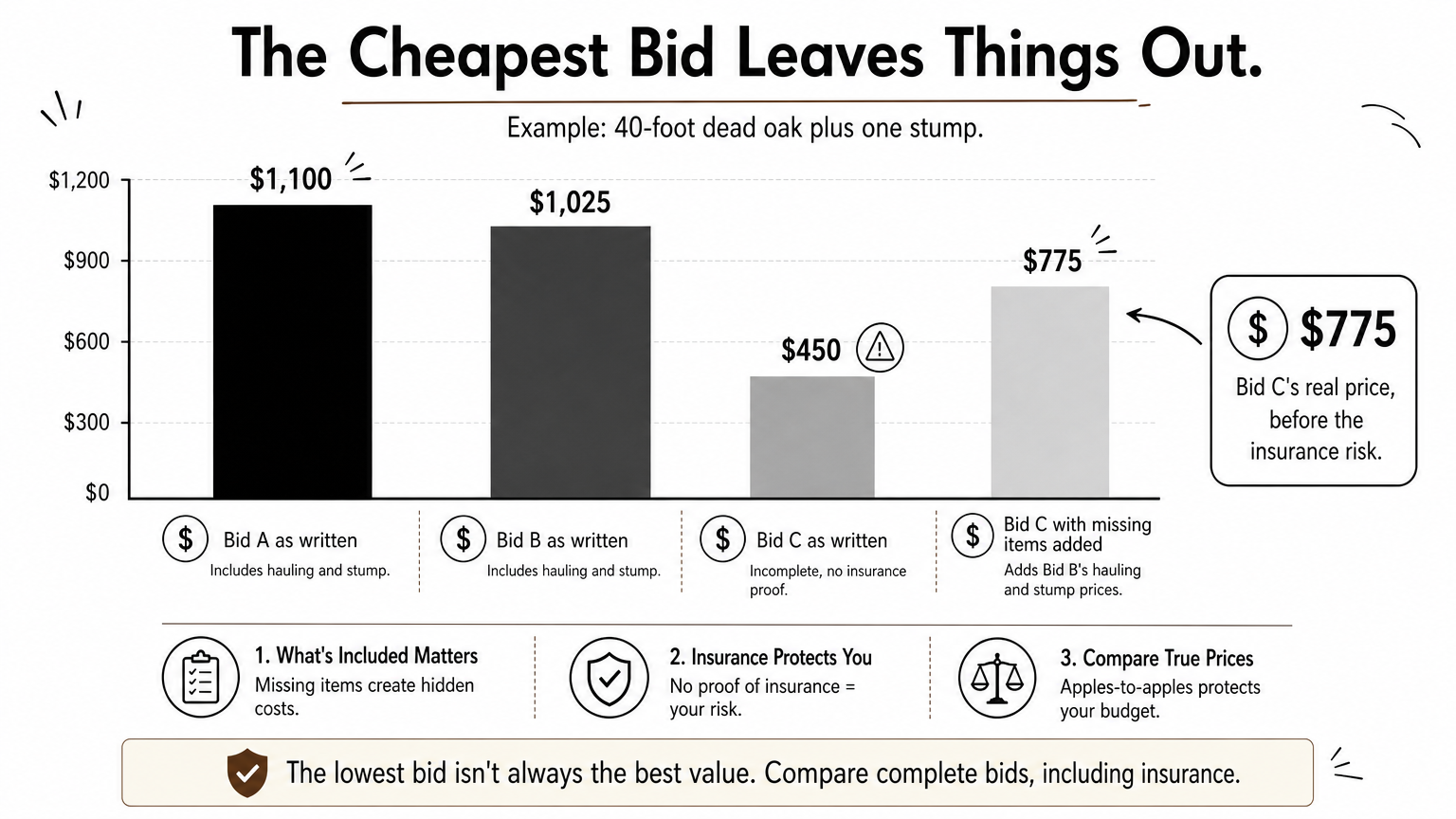
| Line item | Bid A | Bid B | Bid C |
|---|---|---|---|
| Tree removal | $900 | $700 | $450 |
| Debris haul-away | Included | $150 | Not quoted |
| Stump grinding | $200 | $175 | Not quoted |
| Proof of insurance | Yes | Yes | No |
| Total as written | $1,100 | $1,025 | $450 (incomplete) |
Bid C looks cheapest, but it excludes the hauling and the stump. Even if you add Bid B's prices for those two items, it reaches $775 , and with no proof of insurance you carry the risk if something goes wrong. Bids A and B differ by only $75, so choose between them on reliability, communication, and credentials.
Spot the warning signs in pricing
Some pricing patterns should end the conversation.
- A large cash deposit demanded before any work
- No written scope, or a total with no line items
- Pressure to decide today
- A firm price quoted by phone without seeing the tree
- Crews who knock on your door after a storm
- A bid far below the others with no explanation
Add the missing items to the cheapest bid before you call it cheapest.
Step 4. Vet the company and book the job
Before you sign, verify insurance and credentials, then get scope, cleanup, and schedule in writing. A tree that falls on the wrong thing is the contractor's problem only if the contractor is insured.
Verify insurance and credentials
Ask for a certificate of insurance showing general liability and workers' compensation, and confirm with the insurer or agent that the policy is active. A company without workers' compensation can leave you exposed if a worker is hurt on your property.
Ask whether a certified arborist oversees the work, and request the credential number so you can look it up on the ISA website. Also ask for the company's local business license. Requirements vary by city and county, so a legitimate company will know what applies in yours.
Put the agreement in writing
The written agreement should name the following.
- Scope of work and total price
- Who handles permit and HOA checks
- Cleanup, wood disposal, and stump grinding
- Start date and the plan for weather delays
- Payment terms
- Who is responsible for damage to fences, irrigation, or landscaping
Book early if you can. Hurricane season in Southwest Florida runs June 1 to November 30, and demand for crews jumps after any storm. Removing a weak tree before the season is easier and cheaper than an emergency call.
A verified insurance certificate and a signed, itemized scope protect you better than any discount.
Hire on scope, not on the lowest price
A good removal tree service gives you an itemized written estimate, proof of insurance, and a plain explanation of why the tree has to come down. Confirm the need, send the same request to three companies, compare line by line, and verify credentials before you sign. Following those four steps keeps you from paying for a tree that could have been saved, or for a cheap job that leaves the stump and the mess to you.
If you have a tree in North Port, Port Charlotte, or Venice that worries you, talk with ArboBella Tree Service about your tree. You can also call 941-932-1768 to ask about an evaluation.