Tree Services Removal: 5 Local Options and What to Ask Each
The best pick for tree services removal is a licensed, insured company that sends an ISA Certified Arborist to inspect the tree before it quotes a price. A certified arborist company suits dead, leaning, or storm-damaged trees near your home. A large regional company suits big or multi-site commercial jobs. A small independent crew suits an easy tree in open space, if it can prove insurance. A utility or city crew is the right call when the tree touches power lines or stands in public right-of-way.
The problem is that anyone with a chainsaw can advertise tree removal, and quotes for the same tree can differ by hundreds of dollars. A dead pine leaning toward your roof is a bad place to learn the difference between a crew with liability insurance and one without. Most readers also want three things at once: a fair price, a free estimate, and a crew that will not damage the property.
This guide covers five options for homeowners and property managers in North Port, Port Charlotte, Venice, and nearby Southwest Florida. ArboBella Tree Service, the company behind this blog, is listed first, and the other four are described on their own terms. Each option gets the same three checks: how it works, who it suits, and how it prices and estimates. After the list you get the cost drivers, a worked quote comparison, a free-estimate checklist, and the rules to confirm before any cutting starts.
1. ArboBella Tree Service: certified arborist company
ArboBella is the pick for homeowners who want a diagnosis before a decision. It combines an on-site tree evaluation with removal, stump grinding, and emergency response in one local company.
How it works
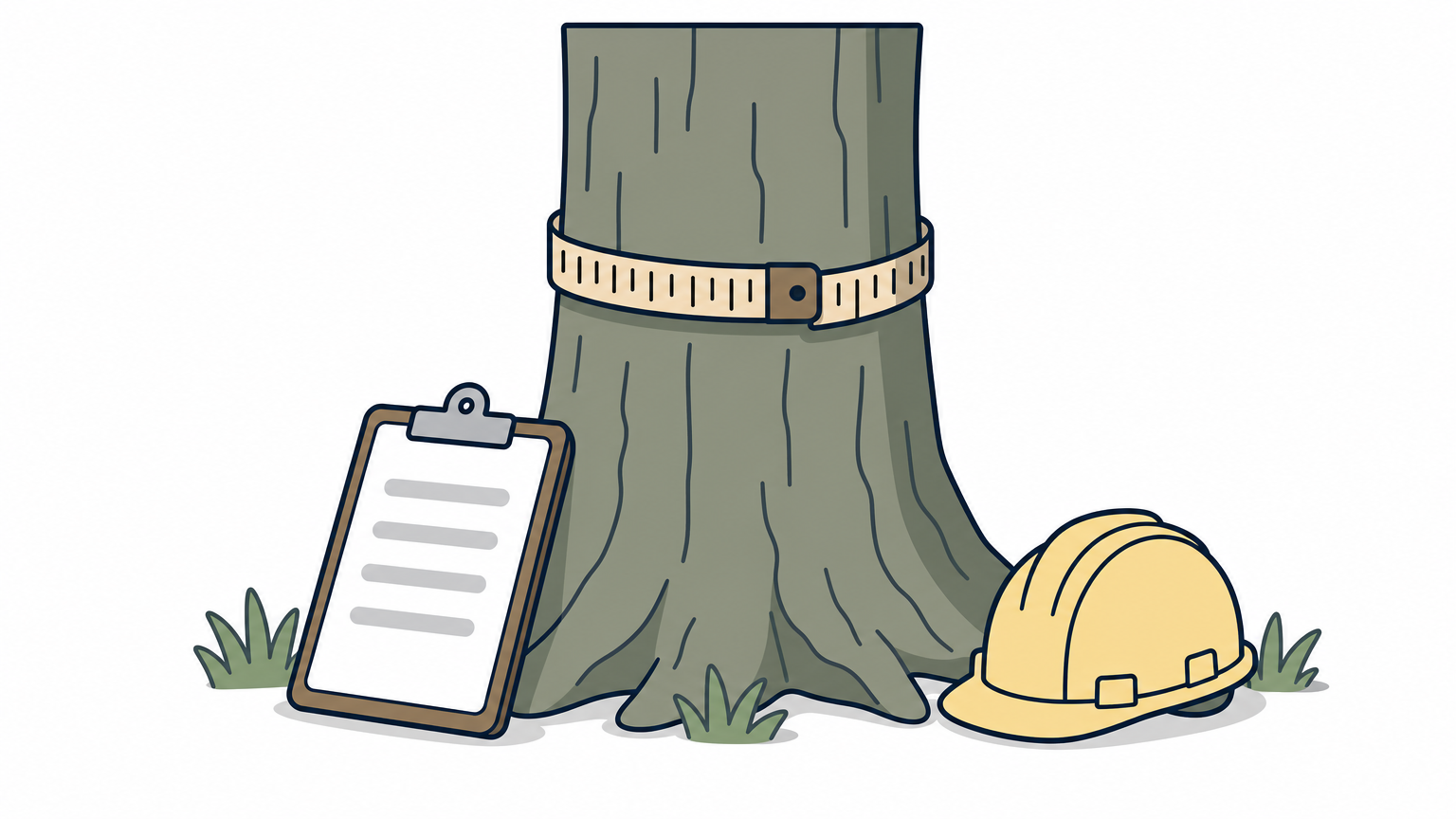
ArboBella is family-owned, based in North Port, and led by an ISA Certified Arborist (FL-295224A) . It is licensed, insured, and has more than 10 years in the industry. Before it recommends pruning, treatment, or removal, the arborist looks at the tree's health, structure, location, and surrounding conditions. The company tries to preserve healthy trees whenever practical , so removal is reserved for dead, declining, damaged, or hazardous trees.
- Tree removal is planned around nearby homes, fences, and landscaping.
- Stump grinding is a separate service. Grinding does not generally excavate the underground root system.
- Emergency service covers fallen trees, hanging limbs, and split trunks.
A certified arborist's first job is to tell you whether the tree really has to go.
Who it suits
It fits homeowners in North Port, Port Charlotte, and Venice who cannot tell whether a tree is dead, declining, or only stressed. Businesses, HOAs, municipalities, and property managers use a separate commercial tree removal line. Homeowners worried about storm risk can also ask about the Homeowner Tree Risk Mitigation Program . It ends with a final inspection by an ISA Certified Arborist and documentation you can show your insurance agent. ArboBella does not promise any discount, premium reduction, or coverage decision.
- Choose it when: the tree is near your house, you want a second opinion, or you want removal and stump work from one crew.
- Think twice when: you only want the lowest possible price for a small tree with nothing nearby.
Cost and estimate
Removal prices depend on the tree, so an on-site evaluation tells you more than a phone quote. Contact ArboBella at 941-932-1768 or info@arbobellatreeservice.com to arrange one. Ask for the estimate in writing, with stump grinding and debris cleanup marked as included or extra.
A diagnosis can also lower your bill. A tree that can be pruned or treated costs less than a full removal , and you keep the shade.
2. Large regional or national tree care company
A big tree care company works like a corporation. You deal with a sales arborist, a scheduling office, and a standard proposal, and the work is done by a larger crew.
How it works
Most large firms send a sales arborist to measure the job and write a proposal, then dispatch a separate crew. They often bundle removal with plant health care or lawn programs. Their size shows in a few ways:
- A bigger equipment fleet, which helps with large trees.
- Formal safety training and standard insurance coverage.
- Back-office support if a job runs late or needs a revisit.
Confirm that the local branch actually covers your address. Some national brands list service areas generously.
Who it suits
This option suits multi-site commercial properties , large trees that need heavy equipment, and owners who want a corporate paper trail. It is a weaker fit for one small tree, where the overhead outweighs the benefit.
Pay for a large company only when the job needs its equipment or its paperwork.
Cost and estimate
Large firms usually quote higher than small crews because they carry more overhead. That premium can be worth it on a complex removal over a roof or pool cage , where one mistake costs more than the quote.
Ask for the proposal in writing, and get at least one comparison quote from a local company so you can see how much of the price is the brand.
3. Small independent tree crew
An independent crew is usually an owner and a few workers with a truck, a chipper, and saws. You often deal with the person who does the cutting.
How it works
Estimates often come by text photo or a quick drive-by, and scheduling can be fast. Because there is little overhead, the quote is often the lowest you will see. Quality varies widely. Some crews are skilled and fully insured, and others are not. You cannot tell which from the ad alone, so you have to check.
- Ask for a certificate of insurance showing liability and workers' compensation coverage.
- Confirm who will actually be on site.
- Get the scope in writing before any work begins.
Who it suits
A good independent crew suits simple removals : a small or medium tree in an open yard with no roof, fence, or wires in the fall zone. Skip this option for trees over structures, anything near power lines, or large dead trees that are brittle and unpredictable.
A low quote is only a bargain if the crew carries the insurance to back it up.
Cost and estimate
Expect the lowest number here, but price the risk too. If a worker is injured or a limb lands on your roof and the crew is uninsured, you can end up exposed to the cost. Also be wary of crews that knock on doors after a storm and ask for a large deposit up front. Compare any quote against one from an insured company before you say yes.
4. Landscaper or lawn care company
Many landscaping and lawn care companies add tree work to their menu. Some do it themselves, and others hire a subcontractor.
How it works
A landscaper usually handles trimming, shrub removal, and small ornamental trees with the equipment already on the truck. For anything bigger, the company often subcontracts to a tree crew and adds a margin. That is not wrong, but you should know who is really doing the work.
- Ask whether the company's own employees will do the cutting.
- Ask whether its insurance covers tree removal, not only mowing and planting.
- Ask who is responsible if something is damaged.
Who it suits
This option suits small trees and overgrown ornamentals that you want handled along with other yard work, such as re-sodding or new beds. It is a poor choice for tall trees, trees over structures, or anything that needs climbing and rigging. Those jobs need a crew trained for them.
Hire a landscaper for small trees, and a tree company for anything you would not climb yourself.
Cost and estimate
Bundling can save a trip charge and give you one invoice. If a subcontractor does the work, the landscaper's markup may erase the savings, so ask for the removal line itemized. Compare it against a direct quote from a tree company to see whether the convenience is worth the difference.
5. Utility, city, or county crew
Public and utility crews are not a general removal service, but in two situations they are the only correct call, and the work may cost you nothing.
How it works
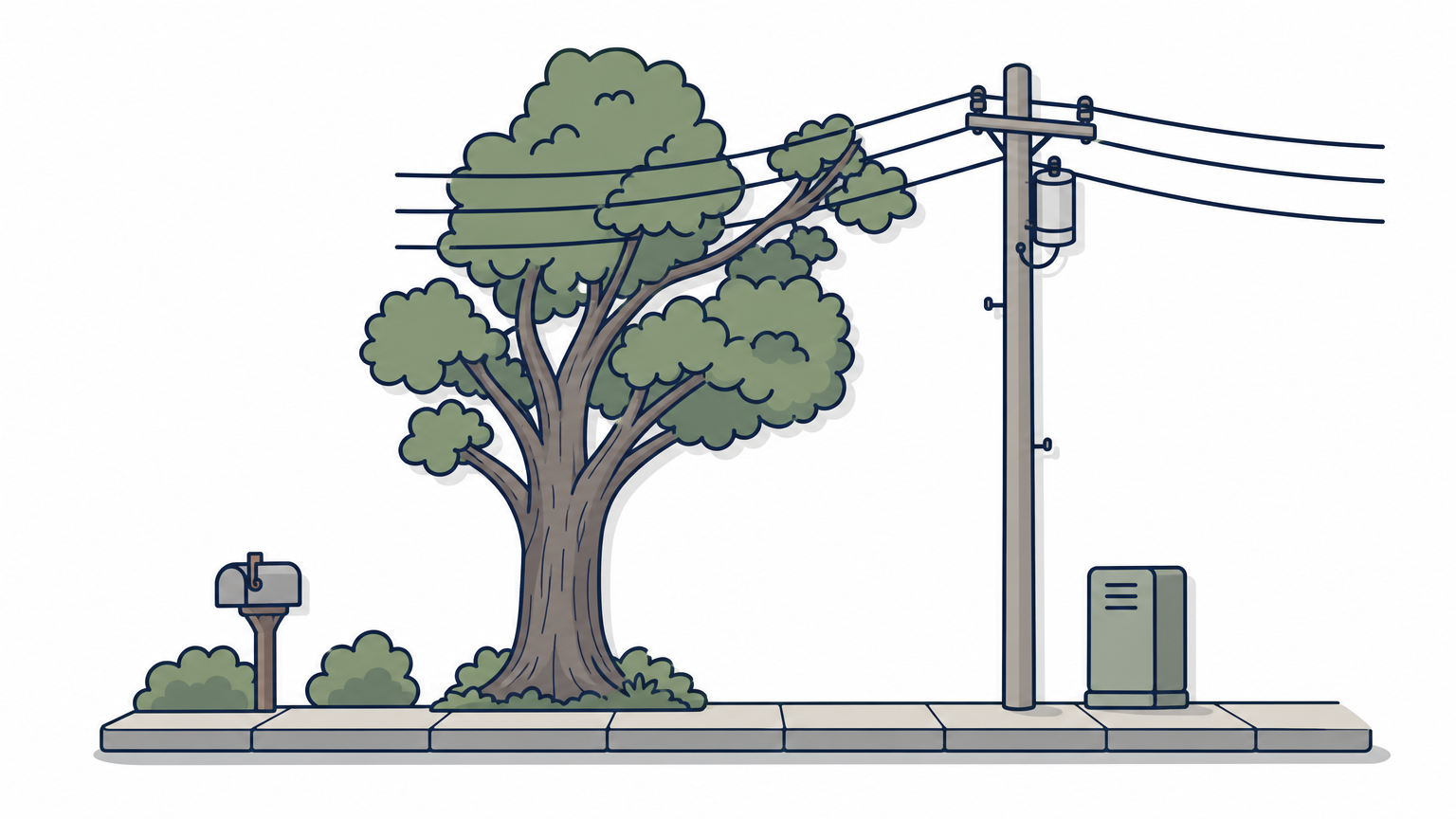
Your electric utility manages trees near its power lines. Cities and counties are generally responsible for trees in public right-of-way, and some run storm debris pickup after major weather. You report the problem, and they inspect it.
- Trees touching or leaning into power lines are a utility job. Never cut near a power line yourself , and keep ladders and crews away from it.
- Trees in a road right-of-way or on public land are the city's or county's call.
- A tree on your own lot is generally your responsibility.
Who it suits
Call them when the tree is in or near the lines , when you are unsure whether a tree is on public or private ground, or when a fallen limb blocks a public road. They are not the answer for a dead tree in your backyard, even if you ask nicely.
If a tree touches a power line, stop and call the utility before you call anyone else.
Cost and estimate
When the tree is their responsibility, the work is generally at no charge to you , though you may wait while they prioritize. When it is yours, they will tell you to hire a private company. The free service is attached to the responsibility, not to your hardship. Ask for a case number so you can show what you reported and when.
What tree removal costs and why quotes differ
Tree removal prices have no flat rate, because the same tree can cost very different amounts depending on where it stands and what is under it. A competitor that quotes you a single number by phone for any 30-foot tree is guessing.
What moves the price
Six factors do most of the work. Read them before you compare quotes, since they explain why two honest companies can land far apart.
| Factor | Pushes the price up | Pulls the price down |
|---|---|---|
| Size and height | Tall tree, thick trunk, heavy limbs | Short tree, light canopy |
| Access | Fenced backyard, no truck reach, climbing or crane needed | Open lawn, chipper close by |
| What is nearby | Roof, pool cage , fence, power lines | Clear fall zone |
| Tree condition | Dead, brittle, split, or leaning | Healthy, predictable wood |
| Add-ons | Stump grinding, full haul-away | Leaving logs for firewood |
| Timing | Emergency calls, post-storm demand | Scheduled work in a quiet period |
Southwest Florida adds one more: hurricane season runs June 1 to November 30, and demand and schedules tighten after any storm . Booking a hazardous tree before a storm threatens is cheaper and calmer than after.
A worked comparison of two quotes
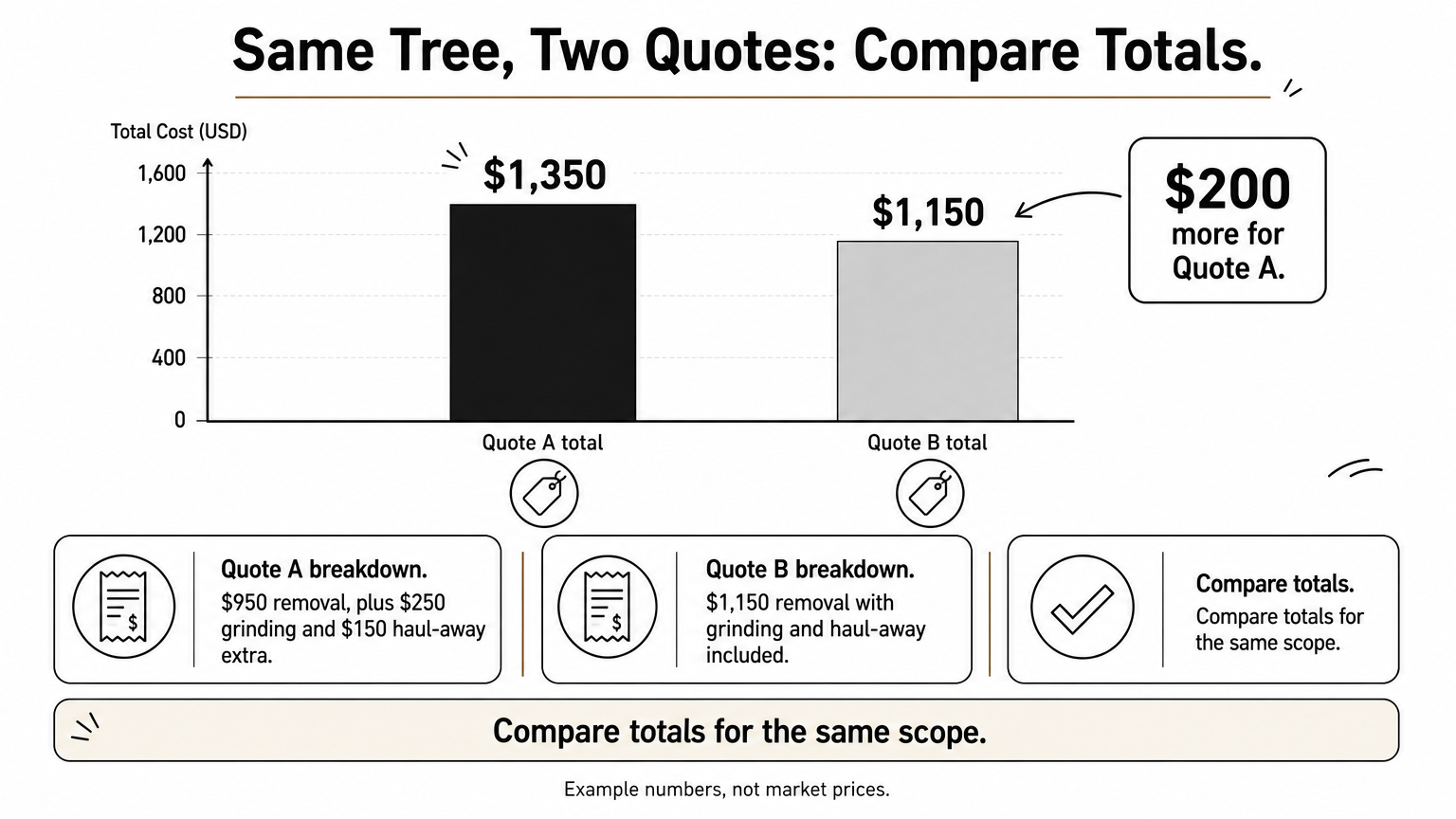
The numbers below are made up to show the method, not market prices. Say you collect two quotes for the same mid-size tree in an open front yard.
| Item | Quote A | Quote B |
|---|---|---|
| Tree removal | $950 | $1,150 |
| Stump grinding | $250 extra | Included |
| Debris haul-away | $150 extra | Included |
| Total | $1,350 | $1,150 |
Quote A looked $200 cheaper at first and ends up $200 more expensive. Always compare totals for the same scope , never the headline line.
Why the stump belongs in the quote
Leaving a stump is rarely a good deal. It can sprout new shoots, rot and attract termites and ants, trip people, and wreck a mower blade. Stump grinding removes it below the surface.
Grinding does not generally dig out the underground roots , so ask the crew how deep they will grind and what the area will look like afterward. Get that depth in writing with the price.
Compare totals, not line items, because extras are where a cheap quote gets expensive.
How to get a free estimate and check local rules
Most reputable companies will look at a tree and give a written estimate, but a free estimate is not the same as free removal. Get several, make them comparable, and confirm what your city, county, or HOA requires before the first cut.
Steps to a useful written estimate
Follow these steps with every company on your list, including the first.
- Contact three companies of different types , such as an arborist company, a regional firm, and an independent crew.
- Point to the same trees and describe the same scope, including stump grinding and debris removal.
- Ask for proof of liability and workers' compensation insurance, sent by the insurer or agent.
- Ask for the arborist's ISA certification number and verify it with ISA.
- Get the scope, price, date, and cleanup terms in writing before work starts.
- Never hand over a large deposit to a crew you cannot verify.
Free estimates versus free tree removal
Free estimates are common, but not universal. Emergency visits and detailed diagnostic evaluations may be charged, so ask before the visit.
Free removal, including for seniors, is not a standard service. Help may come from your city or county, a local nonprofit, an area agency on aging, or your electric utility if the tree touches its lines. Be careful with "free" offers in exchange for the wood. A crew that works for lumber may skip insurance and cleanup.
Permits and rules to confirm
Rules vary by city and county, so check with your local planning or permitting office before removing a tree. Florida law, section 163.045 of the Florida Statutes, generally limits local permit and fee requirements for removing a tree on residential property when you hold documentation from an ISA Certified Arborist that the tree presents a danger. The statute has conditions, so confirm how it applies to your lot.
HOAs and commercial sites often have their own approval steps. Ask your arborist for a written assessment of the tree, and keep it with your estimate and photos.
Making the call on your tree
Choosing among tree removal services comes down to the tree's risk and the crew's proof. A certified arborist company fits trees you are unsure about or that sit near your home. A regional company fits large, complex commercial work. An independent crew or landscaper fits small, simple jobs, and a utility or city crew fits trees on the lines or in public right-of-way.
Whoever you pick, compare written totals for the same scope, ask for proof of insurance, and check the permit rules for your property. If you have a dead, leaning, or storm-damaged tree in North Port, Port Charlotte, or Venice, you can request a tree evaluation from ArboBella Tree Service and get a clear answer on whether it should come down.