How to Get Emergency Tree Service Fast in Southwest Florida
To get emergency tree service quickly, do four things in order. Make the area safe and stay away from the tree. Call a local company that runs a staffed 24/7 line. Confirm its credentials in two minutes. Photograph the damage before anyone cuts. That order shortens the gap between the tree falling and a trained crew stabilizing it.
The problem is that tree emergencies rarely happen at a good time. A limb splits during an evening thunderstorm, or a trunk goes over at 2 a.m. and lands on the roof. You are tired and scared, and you are searching on a phone. Some listings are lead brokers that sell your call to whoever pays. After big storms, out-of-town crews also show up with no insurance. Mistakes made in those first hours cost money and sometimes injuries.
This guide walks you through the process from the first minute to the cleanup. It comes from the way an ISA Certified Arborist-led team like ArboBella Tree Service handles emergency calls in North Port, Port Charlotte, and Venice. You will learn what counts as a true emergency, what to do while you wait, what to say on the phone, how to vet a crew, and how to document the damage for your insurer.
What counts as an emergency tree service call
An emergency is any tree or limb that threatens people, blocks an exit or a road, or is damaging a structure right now. Everything else can wait for a scheduled visit, even if it looks bad. Knowing which side of that line you are on decides who you call first and whether paying for an after-hours response makes sense.
A quick triage of common situations
Use this table to decide who gets your first call. A tree service is the right call for most of these, but a few cases need someone else first.
| Situation | Call first | Then |
|---|---|---|
| Tree or limb touching a power line | 911 and your electric utility | Tree service, after the utility clears the lines |
| Injury, fire, or a tree on an occupied room | 911 | Tree service once everyone is safe |
| Tree on the roof, no one hurt | Emergency tree service | Your insurance company |
| Large limb hanging over a driveway, bedroom, or walkway | Emergency tree service | Arborist evaluation of the rest of the tree |
| Tree leaning with soil heaved up at the roots | Emergency tree service | Arborist evaluation |
| Tree down in an open yard, no damage | Standard scheduling, next available day | Cleanup and stump plan |
Lines are the one case where a tree company cannot help first. Crews do not work near energized conductors until the utility says it is safe.
If a person or a power line is involved, call 911 before you call any tree company.
Why trees in this area fail so suddenly
Southwest Florida produces a lot of these calls. Hurricane season runs June 1 through November 30, and summer thunderstorms bring strong gusts almost daily. Our sandy soil also loses its grip when it is saturated, so a tree with a healthy-looking crown can still tip because its roots let go.
Past damage matters too. A tree that was topped, has a codominant split trunk, or has decay at the base can fail in a wind it would have survived five years earlier. That is why a good 24 7 emergency tree removal crew looks at the whole tree, not just the piece on the ground. Often the part still standing is the next hazard.
Step 1. Make the site safe before you call
Get everyone away from the tree, keep pets inside, and treat every wire as live. Your job in the first few minutes is not to fix anything. It is to avoid becoming part of the emergency while you wait for a crew.
Stay clear and watch for lines
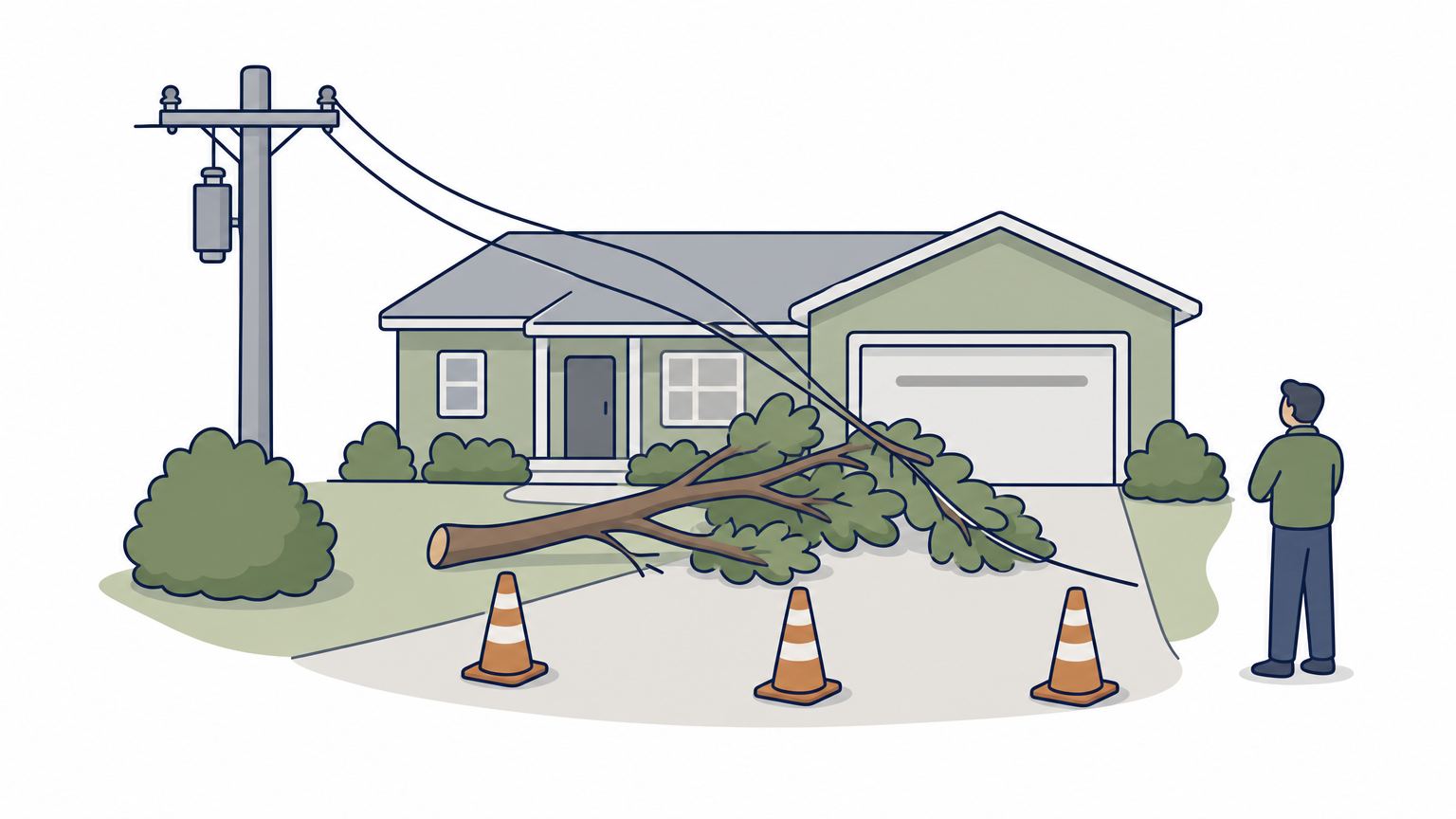
Downed or sagging lines can energize the ground, a fence, or a tree. A common utility guideline is to stay at least 30 feet back and assume every line is live. Report lines to your electric utility and 911, then keep neighbors and children away.
Run through this short list before you dial a tree company:
- Move everyone out of rooms under or next to the damaged tree.
- Shut off nothing near the tree unless you can reach it without going under limbs.
- Keep cars out of the fall zone if you can move them without approaching the tree.
- Block the driveway or sidewalk with cones, chairs, or tape.
- Note whether the tree is still moving, creaking, or shifting. You will be asked.
Leave the cutting to the crew
Trees that have fallen or split are under tension. A trunk resting on a roof or fence can roll, kick, or snap back when you cut the wrong piece. Homeowners with chainsaws are hurt more often in storm cleanup than in routine pruning, usually because they are on a ladder or standing under a hung-up limb.
A professional crew reads the load paths first. It then rigs the heavy sections, lowers them, and removes pressure in a planned order. That is what you are paying for in an emergency, and it is why emergency tree service is a skilled job and not just a faster version of regular tree work.
Your only job before the crew arrives is to keep people away from the tree.
Step 2. Call a 24/7 emergency tree service
Call a company that is local, answers its phone with a person, and explicitly offers 24/7 emergency tree service. Speed comes from short drive times and a real dispatcher, so proximity matters more than a flashy ad.
Choose who to call
Start with companies based near you. A truck from North Port reaches a Venice or Port Charlotte address far sooner than one dispatched from across the state. Look for a physical service area, a named arborist, and a phone number that rings a crew, not a call center. If a site shows a generic name and no address, it may be a lead broker.
If you can, call two companies. Many will give you a rough arrival window in the first minute. Take the one that commits to a clear window and a written estimate, not the one that promises "30 minutes" for everything.
Say these five things
Dispatchers sort calls by hazard. The more precisely you describe the situation, the sooner the right crew and equipment arrive. Read from this script:
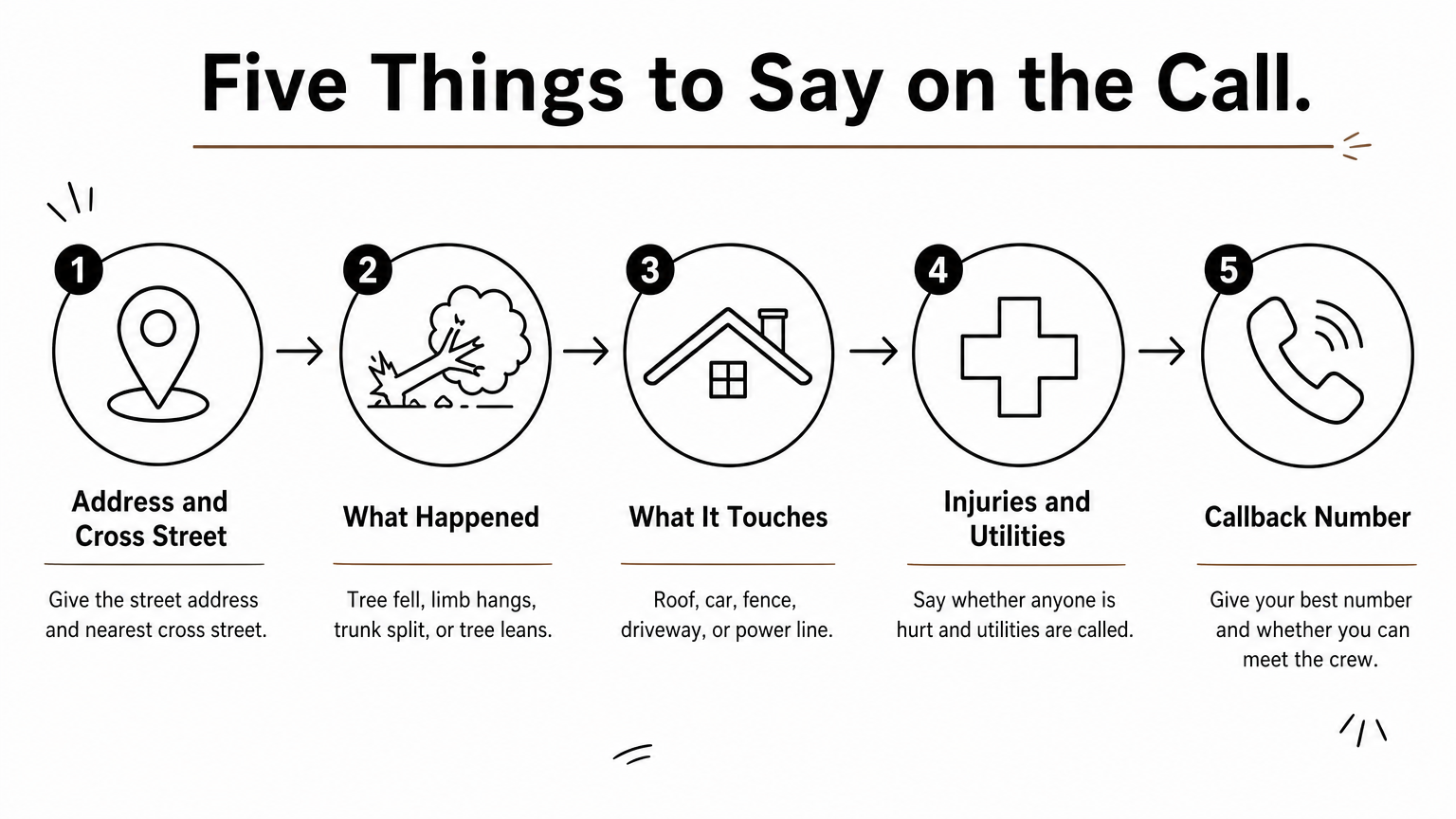
 1. Address and the nearest cross street.
2. What happened: tree fell, limb is hanging, trunk split, or tree is leaning.
3. What it is touching or blocking: roof, car, fence, driveway, power line.
4. Whether anyone is hurt and whether utilities have been called.
5. The best number to reach me, and whether I can be here to meet the crew.
Then ask three questions: what is your arrival window, will an arborist assess it first, and does an after-hours fee apply? After-hours and holiday rates are common. A reputable company tells you up front and gives a written estimate before cutting starts.
A staffed phone line and a straight answer about arrival time beat a promise of speed.
Step 3. Verify the crew before they cut
Spend two minutes confirming a crew's credentials while the crew is on the way. A real 24/7 emergency tree removal company expects the question and answers it without hesitation. A company that gets defensive is telling you something.
The four checks that matter
| Check | What to ask | Why it matters |
|---|---|---|
| Certified arborist | Is an ISA Certified Arborist on the job? What is the certification number? | You can look up a certification number on the ISA's website, and it shows real training in tree risk. |
| Liability insurance | Can you send a certificate of insurance? | Falling trees damage property. Uninsured crews leave you holding the bill. |
| Workers' compensation | Does the crew carry it? | Without it, an injured worker on your property can become your problem. |
| Local licensing | Do you hold the local business tax receipt or permit my city or county requires? | Requirements vary by municipality, and a legitimate company knows them. |
ArboBella, for example, is led by an ISA Certified Arborist (FL-295224A) and is licensed and insured. That is the type of answer you should expect from any company you call.
Red flags after a storm
Door-to-door crews with out-of-state plates are a common sign of storm chasers. Be careful with anyone who demands cash up front, refuses to put the scope and price in writing, or pushes you to sign immediately. Another warning sign is a crew that wants to "top" a damaged tree. Topping leaves weak regrowth, and it often creates the next hazard.
You are not being rude by asking questions. If a company will not answer them, call the next one.
A legitimate emergency crew proves its credentials without being asked twice.
Step 4. Document the damage and plan the cleanup
Take photos before anything moves, get a written scope, and keep every receipt. A few minutes of documentation protects your insurance claim and makes the cleanup go faster, whether you called a 24/7 emergency tree service at midnight or at noon.
Photograph and record first
If it is safe, take pictures from a distance before the crew arrives. Pictures from before cutting begins are the strongest evidence you will have later. Use this checklist:
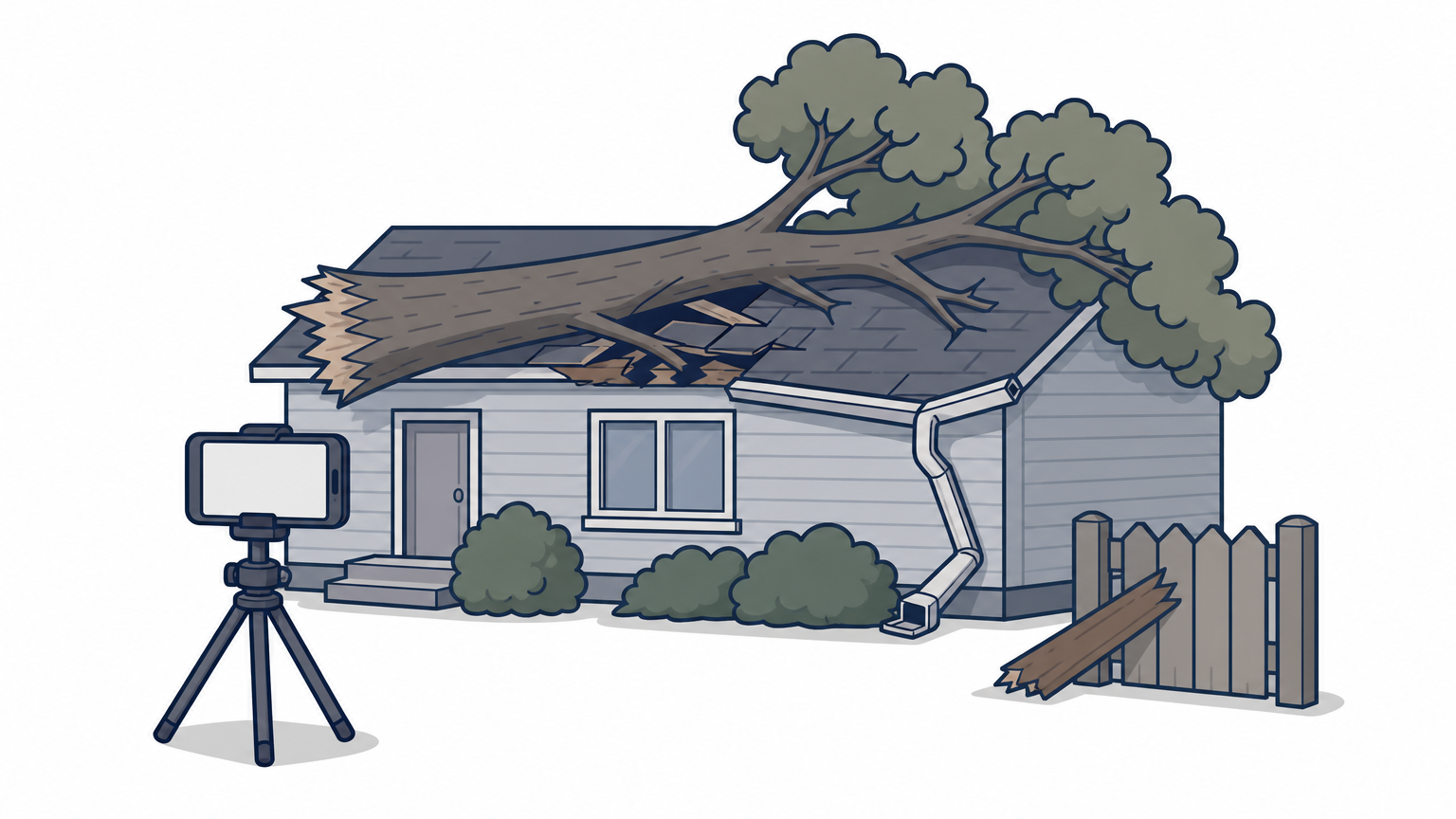
- Wide shots showing the tree, the structure it hit, and the surrounding yard.
- Close-ups of broken roofing, fences, cars, screens, or gutters.
- The base of the tree, including any lifted soil or exposed roots.
- A short video panning from the trunk to the damage.
- Date, time, and a note on the weather.
Ask the crew to photograph the work as it goes, and keep their written estimate and final invoice together with your pictures.
Insurance and what comes after
Coverage varies by policy. Homeowners insurance often pays to remove a tree that has damaged a covered structure, but may limit or exclude removal when a tree falls with no damage. Debris removal caps and deductibles also vary. Read your policy, call your insurer before you authorize major work, and ask what they need from the tree company.
Once the emergency is stabilized, finish the job properly. Ask the arborist to evaluate the other trees on the property, particularly any with the same species, lean, or decay. Then plan the stump and debris, since a fallen trunk often leaves a stump that still needs grinding. A good company cleans up logs and brush and walks the site with you before leaving.
Photos taken before the first cut are your best evidence for any insurance claim.
Keep the call simple
When a tree comes down, the best response is a calm, ordered one. Get people away from the tree, call 911 first when lines or injuries are involved, phone a local 24/7 crew, check its credentials, and photograph everything before the work starts. Skip the DIY cutting. It is where most storm injuries happen.
If you are in North Port, Port Charlotte, or Venice and a tree is hanging, split, or down, contact ArboBella's emergency tree crew and describe the situation. A certified arborist can tell you what is urgent, what can wait, and whether the tree can be saved.