Removal of Tree Stumps Cost: What You Should Expect to Pay
The removal of tree stumps cost is what a tree service charges to grind, dig out, or otherwise destroy the stump left behind after a tree comes down. For a single stump, most homeowners pay roughly $150 to $600. Grinding usually runs $150 to $500, and full extraction runs $200 to $1,000. Contractors typically price by diameter at about $2 to $5 per inch, then apply a minimum charge of $100 to $150. Small stumps rarely come in under that minimum.
This guide gives you the numbers and the reasoning behind them. You will see price ranges by stump size and by method, learn what pushes a quote up or down, and get a simple process for collecting quotes you can compare side by side. By the end, you should be able to look at a contractor's number and tell whether it is fair.
ArboBella Tree Service, led by an ISA Certified Arborist, grinds stumps for homeowners and commercial properties in North Port, Port Charlotte, and Venice. The figures below are national ranges, not our price list. Use them as a yardstick for any quote you receive, ours included.
Why the cost of stump removal is worth understanding
Stump pricing is worth understanding because the overall range is predictable while individual quotes are not. Two contractors can look at the same stump and differ by a few hundred dollars. A stump is also almost never included in a tree removal price, so it arrives as a second line item that most homeowners did not budget for. That is why the removal of tree stumps cost deserves its own check before you agree to anything.
Why a stump is worth paying to remove
A stump is not harmless once the tree is gone. Decaying wood invites pests , and in Southwest Florida that means termites and ants working close to the buildings on your property. A hidden stump in turf also becomes a trip hazard and a mower-blade killer. These are the usual reasons homeowners pay to remove one:
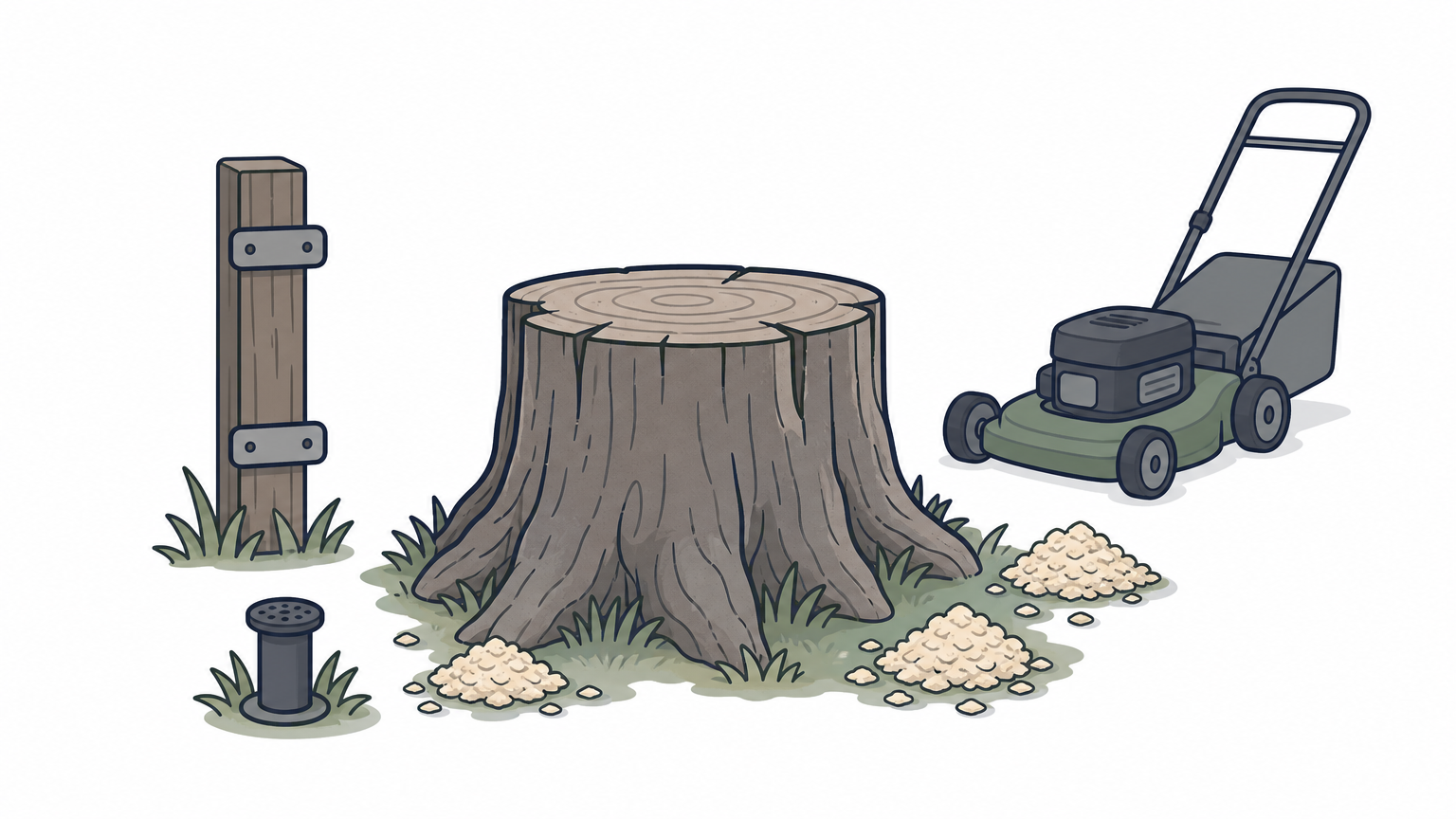
- Termites, ants, and rodents settle into decaying wood.
- Stumps hidden in grass cause falls and damage mowers.
- A diseased stump can pass fungi to nearby healthy trees.
- Stumps block new planting, patios, fences, and irrigation work.
- A leftover stump drags down curb appeal.
Leaving a stump is a legitimate choice if it sits in a corner you never use. Just know that decay takes years, so the stump will not solve itself.
Typical price ranges by stump size
Most grinding jobs fall into three bands by diameter. Small stumps under 12 inches run about $100 to $150. Medium stumps of 12 to 24 inches run about $150 to $300. Large stumps over 24 inches run $300 to $700. The table sets those quoted ranges next to what simple per-inch math produces.
| Stump diameter | Per-inch math at $2 to $5 | Typical quoted range for grinding |
|---|---|---|
| 12 inches | $24 to $60 | $100 to $150 (minimum charge applies) |
| 18 inches | $36 to $90 | $150 to $300 |
| 24 inches | $48 to $120 | $150 to $300 |
| 36 inches | $72 to $180 | $300 to $700 |
| 48 inches | $96 to $240 | $300 to $700 or more |
Across published national estimates, the average single stump lands near $325 to $370, and most homeowners pay between about $195 and $609. Full extraction costs more, usually $200 to $1,000. Treat these as blended national figures. Your location and your particular stump will move the final number.
How per-inch pricing works
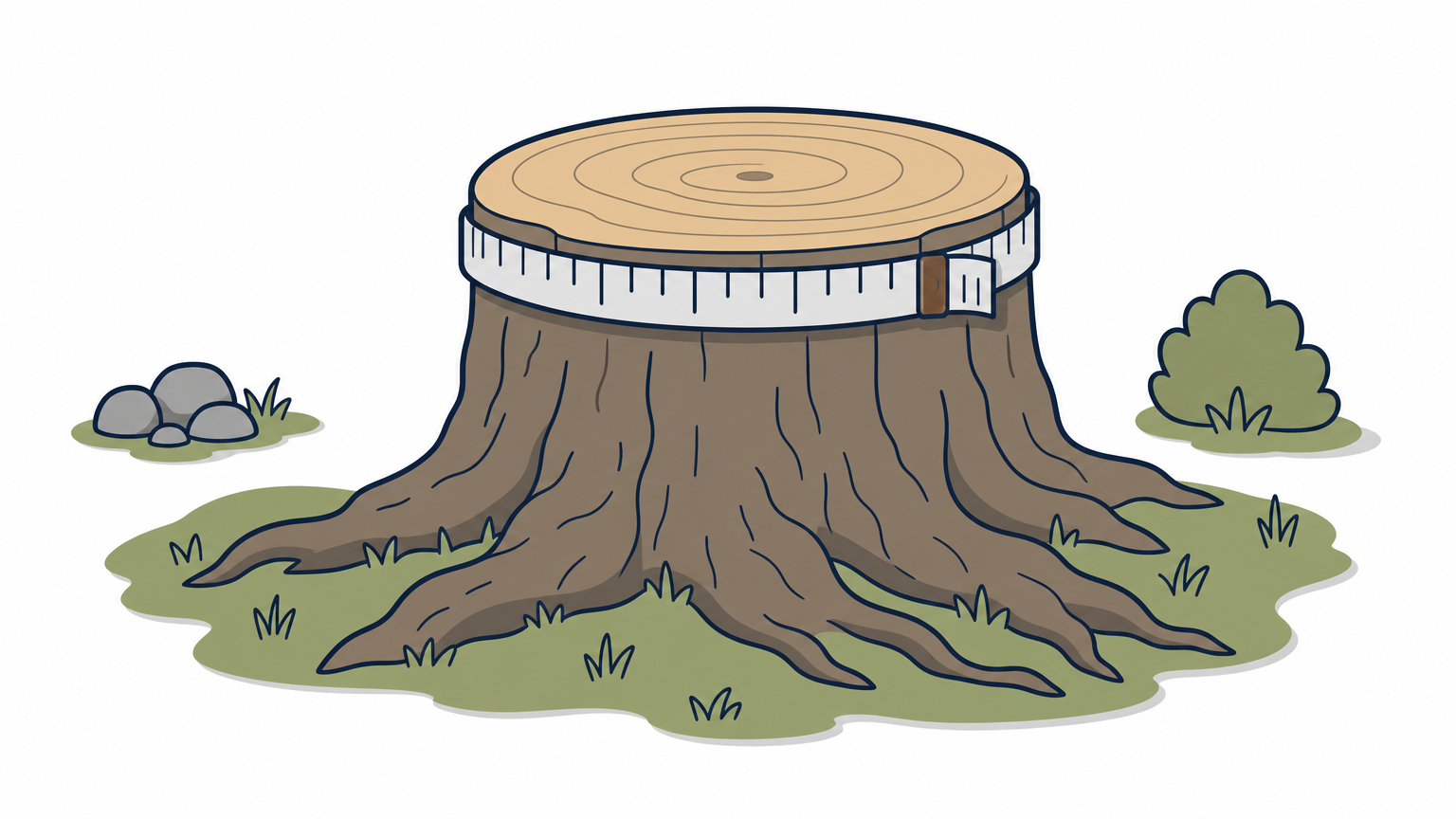
Per-inch pricing multiplies the stump's diameter by a rate, usually $2 to $5, and then applies a minimum charge. Measure diameter at the widest point across the top of the stump. If you only have a tape measure, wrap it around the stump and divide the result by 3.14. Ask the contractor where they measure, because a flared base can add inches to their count.
The table above shows a catch. Per-inch math for a 12-inch stump gives $24 to $60, far below any minimum. That is why small stumps cost the minimum charge and why large stumps often quote well above the formula. Contractors add for roots, hard wood, and tight access. Treat the per-inch rate as a floor, not a final price.
Per-inch rates set the floor, while the minimum charge and your site conditions set the actual bill.
What pushes a stump removal quote up or down
Diameter sets the starting price, and then roots, wood density, access, and cleanup move it. Knowing which of these apply to your stump tells you whether a quote should land at the low or high end of the typical removal of tree stumps cost.
Size, species, and root system
Bigger stumps cost more because they take more machine time, and diameter is the single biggest driver . Species comes second. Dense hardwoods such as oak and hickory dull grinder teeth and slow the job. Palms and pines are softer and go faster. An older, partly rotted stump is also quicker work than one cut last month.
Roots come third. Surface roots can add $50 to $100, deep root systems can add $150 to $350, and extensive lateral roots can raise a price by 25 to 50 percent. If you want roots dug out rather than ground, crews typically bill $100 to $185 per hour. Mature oaks with wide, shallow roots are where these add-ons show up most.
Access and site conditions
Access decides how easily the machine reaches the stump. A stump behind a narrow gate or tight against a house forces a smaller machine or hand work, and that costs more labor. These are the situations that most often add to a quote:
- Fence-line stumps: often a 20 to 50 percent premium.
- Slopes and hillsides: roughly $50 to $100 extra.
- Stumps near structures, pool cages, or utility lines: slower, more careful work.
- Rocky or compacted soil: extra wear on cutting teeth, so higher rates.
Sandy soil, common in Southwest Florida, is easy on equipment compared with rock. Irrigation lines, pavers, and screen enclosures are the usual hazards instead. Mark your sprinkler heads, and call 811 before anyone digs so buried utilities are located first.
Cleanup, fill, and other extras
Grinding leaves a pile of wood chips and a shallow depression, so cleanup is where many quotes quietly diverge. One contractor includes haul-away, another bills it separately. Ask what is included before you compare totals, and count every extra before deciding which quote is lower.
| Add-on | Typical cost |
|---|---|
| Debris haul-away | $1 to $4 per diameter inch |
| Filling the hole with soil | $50 to $100 or more |
| Sod or grass seed | Varies by area |
| Additional stumps in one visit | Often 10 to 20 percent off each extra stump |
| Tree removal before the stump | $200 to $2,000, billed separately |
| Permits, where local rules require them | Roughly $100 to $500 |
You can keep the chips yourself as mulch or fill and skip the haul-away fee. If a tree still needs to come down, ask whether tree and stump removal in a single visit saves you a second minimum charge.
Compare quotes by what is included, because a cheap grinding price with extra cleanup fees can cost more than a higher all-in number.
Stump removal methods and what each one costs
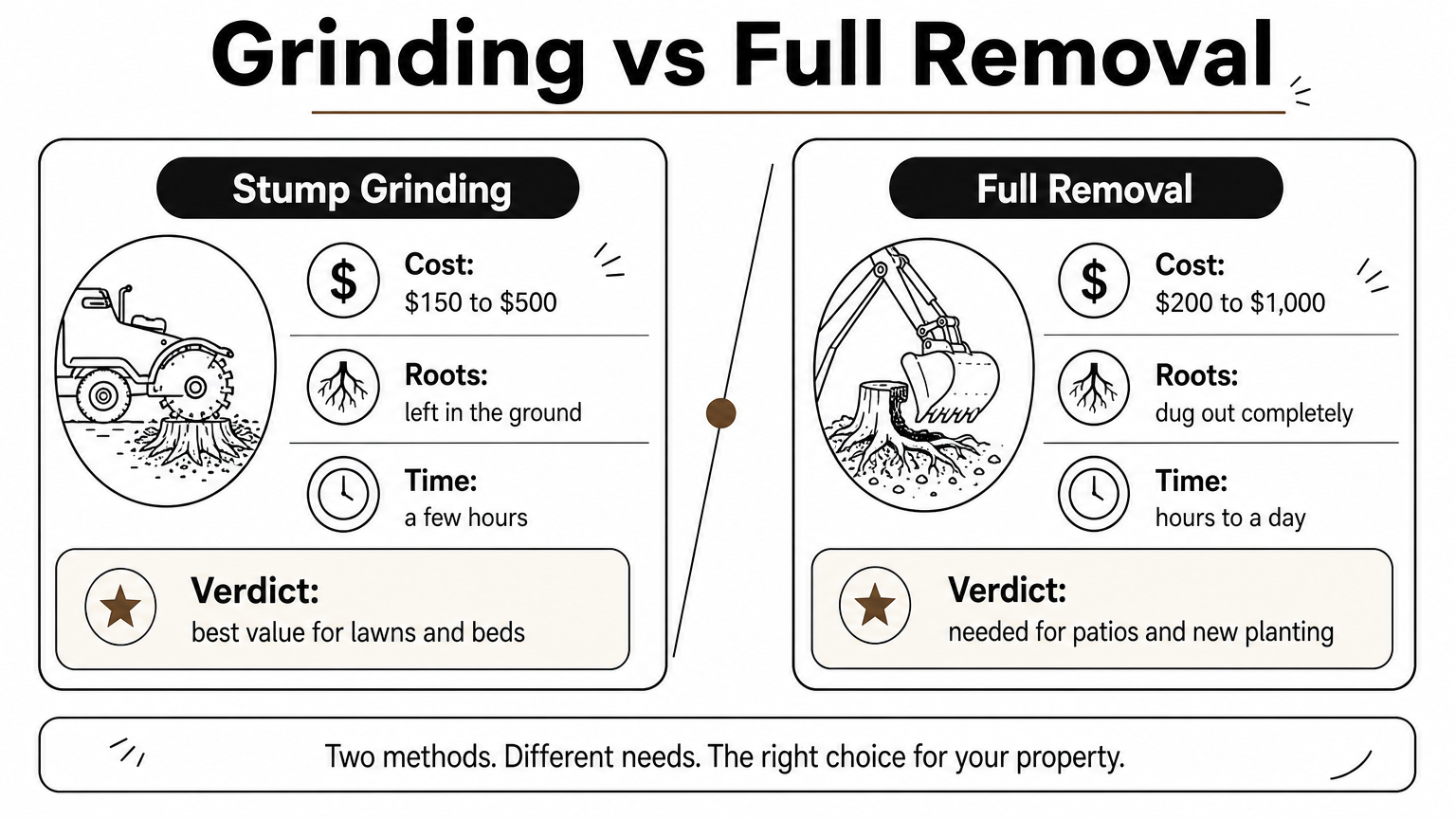
Grinding is the standard choice and usually the best value, at roughly $150 to $500. Full extraction costs more but removes the roots. Chemical rotting and burning are cheaper on paper, but one is slow and the other is often restricted. This table compares them side by side.
| Method | Typical cost | Roots removed | Time to finish |
|---|---|---|---|
| Stump grinding | $150 to $500 | No, only the stump and upper roots | A few hours |
| Full removal | $200 to $1,000 | Yes | Hours to a day |
| Chemical rotting | $60 to $200 by a pro, about $10 in granules DIY | No | Weeks to months |
| Stump burning | $100 to $200 | No | A few hours |
Grinding versus full removal
A grinder shreds the stump into chips a few inches below the surface and leaves the roots in the ground. That is enough for lawns, flower beds, and replanting grass , because the remaining roots decay over the years. Full removal digs out the stump and the root mass with heavy equipment. It is the priciest option, and it is the only one that gives you a clean slate.
Choose full removal when you are pouring a patio, building a structure, or planting a new tree in the same spot. Grinding is the better value everywhere else. Roots left behind rarely cause trouble, but some species send up sprouts from them. If you see shoots, cut them back promptly.
Chemical rotting and burning
Chemical rotting is the cheapest way to deal with a stump, and DIY granules cost about $10. You drill holes, add the chemical, and wait. The stump softens over weeks to months , and thick or deep-rooted stumps can resist the treatment. Handling concentrated chemicals is risky around children and pets.
Burning is faster but carries fire risk. Stray embers can ignite fences, mulch, and dry lawn. Many cities restrict or prohibit both burning and chemical treatment, and burn bans are common in dry weather. Check local rules first , because these methods are often unavailable in residential neighborhoods.
Renting a grinder versus hiring a pro
Renting a stump grinder typically costs $190 to $360 per day, before delivery, safety gear, and your time. A pro charges about $150 to $500 for a typical stump and arrives with a machine sized for the job. Renting only starts to make sense with three or more stumps you can finish in one day, and only if you are comfortable operating a machine with spinning cutting teeth.
Manual removal with a shovel, mattock, and saw costs the least in cash and the most in labor. It works for small, young stumps. For anything with a mature root system, it turns into a multi-day project.
Grinding gives the best balance of price, speed, and results for most stumps, and full removal is worth the extra only when you need the roots gone.
How to get a fair quote and keep the bill down
Get at least three written quotes for the same scope of work, then compare them line by line. The point is to make the quotes comparable, so you are judging price rather than differences in what each contractor assumed.
Steps to get comparable quotes
Preparation takes about fifteen minutes and makes the quotes you receive much more accurate. Work through these steps before you call anyone:
- Measure each stump's diameter at its widest point and count the stumps.
- Take photos of the stumps, nearby fences, structures, and gate widths.
- Decide whether grinding is enough or you need the roots removed.
- Decide who handles chips, fill, and sod.
- Send identical details to three licensed and insured stump removal companies and ask for itemized written quotes.
A message like this works well when you contact each company:
 Hi, I need a quote for stump grinding at [address].
Stumps: [number], diameters about [X] inches each.
Photos attached. Access is through a [X]-foot gate.
Please itemize: grinding, root work if any, haul-away of chips,
hole fill, and any minimum charge.
Please confirm you are licensed and insured.
Thanks, [name and phone]
Checking a quote for fairness
A quick estimate helps you test a number. Start with the quoted range for your stump's size, add access and cleanup, and compare. Take a 24-inch stump behind a tight gate where you want the chips hauled away. The base grinding range is $150 to $300. Add $50 to $100 for access, plus $24 to $96 for haul-away at $1 to $4 per inch. That puts a reasonable all-in estimate around $224 to $496 . A quote inside that band is fair, while one far above it needs an explanation.
Watch for these red flags:
- No itemization of what the price covers.
- A price far below the minimum charges described above.
- A demand for full payment before any work starts.
- No proof of insurance.
- Vague answers about cleanup.
Ways to lower the bill
The easiest savings come from reducing the contractor's labor and trips. Bundle every stump into one visit , because per-stump rates usually drop after the first. Clear rocks, toys, and décor out of the way, and expose the surface roots by raking back mulch. Keep the chips for mulch to skip the haul-away fee.
Scheduling also matters. Avoid emergency calls, ask about flexible dates, and ask whether combining tree removal and grinding in one visit cuts your cost. Florida has no true off-season for tree work, so savings come from flexibility rather than from timing the calendar. Never choose a contractor on price alone. An uninsured crew that damages a sprinkler line or a pool screen can cost far more than the money you saved.
A fair quote is itemized, matches your stump's size and site conditions, and comes from a licensed, insured crew.
Putting a number on your stump
The removal of tree stumps cost comes down to a few things you can measure: diameter, roots, access, and cleanup. Expect roughly $150 to $500 for grinding and $200 to $1,000 for full extraction, with a minimum charge of $100 to $150 on small jobs. Use the per-inch rate as a floor and the size bands as your realistic range.
Once you have your measurements and photos, you are ready to compare real quotes. If your property is in North Port, Port Charlotte, or Venice, you can ask ArboBella Tree Service for an on-site stump grinding quote and check it against the ranges in this guide.