Tree Branch Removal Near Me: How to Hire in North Port
The fastest way to get tree branch removal near me done right is to define the job first, then collect two or three written quotes from insured, ISA Certified Arborists and compare what each one includes. Photograph the branch or tree, note how close it sits to your roof and power lines, and ask for an itemized price that covers cleanup. Choose the clearest scope, not the lowest number.
Search results for this phrase are mostly directories and ad-driven lists, and they hide the real problem. "Branch removal" can mean a 20-minute job from the ground or a full day of rigging. A dead tree can look fine until the wood fails under a climber's weight. Without knowing size, access, and condition, quotes cannot be compared, and the cheapest bid often comes from a crew without insurance.
This guide walks you through four steps: identify the job, understand what drives the price, vet the provider, and book and prepare the site. It works for a single limb, a large tree, or a dead tree. It is written from the view of ArboBella Tree Service, an arborist-led company serving North Port, Port Charlotte, and Venice, so the examples fit Southwest Florida properties.
What tree branch removal covers and who should do it
Branch removal means cutting limbs from a tree you plan to keep. Large tree removal and dead tree removal are separate jobs with different risks, equipment, and prices, so name the right one before you call anyone.
Three jobs that share one search
Most people searching for tree branches removal near them have one of three jobs in mind. The table shows how they differ.
| Job | What it involves | What the crew needs |
|---|---|---|
| Branch removal | Cutting deadwood, damaged limbs, or limbs that touch a roof or block a driveway | Climber or lift, chipper |
| Large tree removal | Taking a tall or wide trunk down in sections near structures | Climbers, rigging, often a crane or lift |
| Dead tree removal | Removing a tree whose wood has died and turned brittle | Experienced crew, careful assessment, rigging |
Many calls start as branch jobs and become tree jobs once an arborist looks at the trunk. That is normal. A tree evaluation before any cutting keeps you from paying to prune a tree that cannot be saved, or removing one that could have been.
When to skip the DIY route
Hire a professional for any limb you cannot cut while standing on the ground. That includes anything over your head, over a roof, or near a power line. Ladders and chainsaws cause serious injuries every year, and a limb under tension can spring back without warning.
Treat a hanging limb, a split trunk, or a tree on a structure as an emergency. Call right away instead of waiting on three quotes. If a limb touches a power line, stay away and call the utility first.
If you cannot cut it from the ground with hand tools, it is a job for a trained crew.
Step 1. Identify exactly what needs to come off
A clear description gets you accurate quotes and fewer surprises on the day. Spend 15 minutes gathering the facts below before you call anyone.
Photograph and measure the job
Take photos from three angles, including one from a distance that shows the tree next to your house. Then note these details:
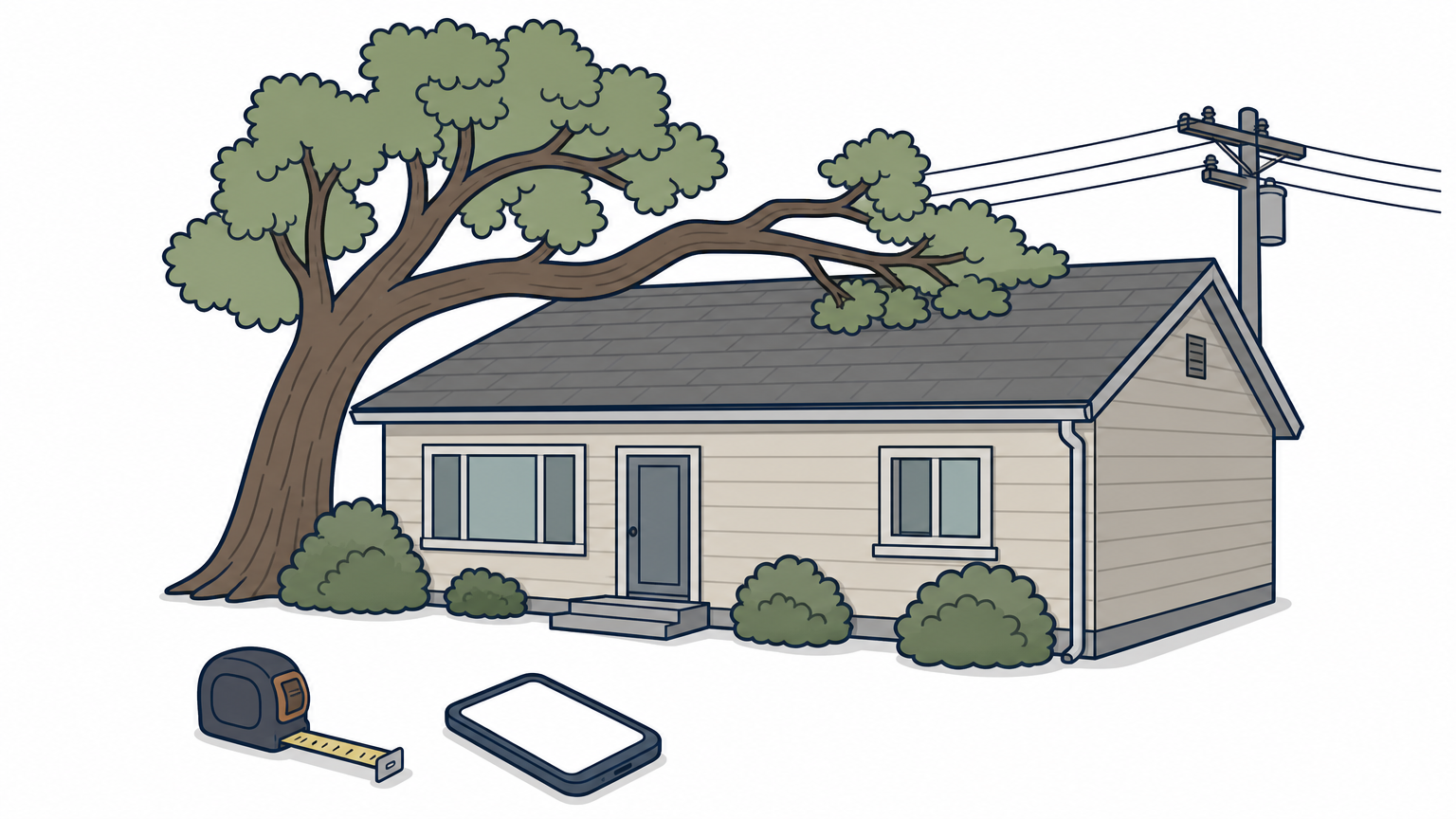
- Approximate height and trunk diameter at chest height
- Distance to your roof, fence, pool cage, and power lines
- How a truck and chipper would reach the tree, including gate width
- Whether limbs hang over a neighbor's property
Send these with your request. A crew that can see the site gives you a tighter estimate, though a final price still needs an on-site look for anything large.
Check whether the tree is dead or declining
A dead tree is more dangerous than a healthy one of the same size because the wood is brittle and can fail without warning. Look for bark peeling in sheets , mushrooms or conks at the base, cracks in the trunk, and large limbs with no leaves or buds during the growing season. Bare branches alone do not prove the tree is dead, since some trees drop leaves seasonally.
Scratch a small twig. Green tissue underneath means life. Brown and dry means that limb is dead. If you are unsure, an arborist diagnosis is the right first step, because the answer decides whether you need pruning, treatment, or removal.
Know whether the tree is alive before you decide how much of it should come down.
Step 2. Understand what drives the price
Tree work is priced by risk and labor, not by the branch. Two jobs that look alike from the street can cost very different amounts because of access, proximity, and condition.
What moves a quote up or down
| Factor | Pushes the price up | Keeps the price down |
|---|---|---|
| Size | Tall, wide, heavy limbs or trunk | Small limbs a climber can lower by hand |
| Access | Backyard with no truck route, locked gates | Open driveway, room for a chipper |
| Nearby hazards | Roof, power lines, pool cage, fences | Open lawn |
| Condition | Dead or decayed wood needing extra rigging | Healthy, predictable wood |
| Debris | Full haul-away, wood hauled off | Wood left for you |
| Timing | Emergency or after-hours calls | Scheduled, flexible dates |
Stump grinding is usually priced separately. It grinds the stump but generally does not remove the underground roots, so ask what the crew leaves behind.
Compare quotes line by line
Headline numbers mislead. These hypothetical figures show why. Quote A is $900 and includes removal, cleanup, and haul-away. Quote B is $700 for removal alone, plus $150 for haul-away and $100 for cleanup. Quote B totals $950, so the "cheaper" bid costs $50 more.
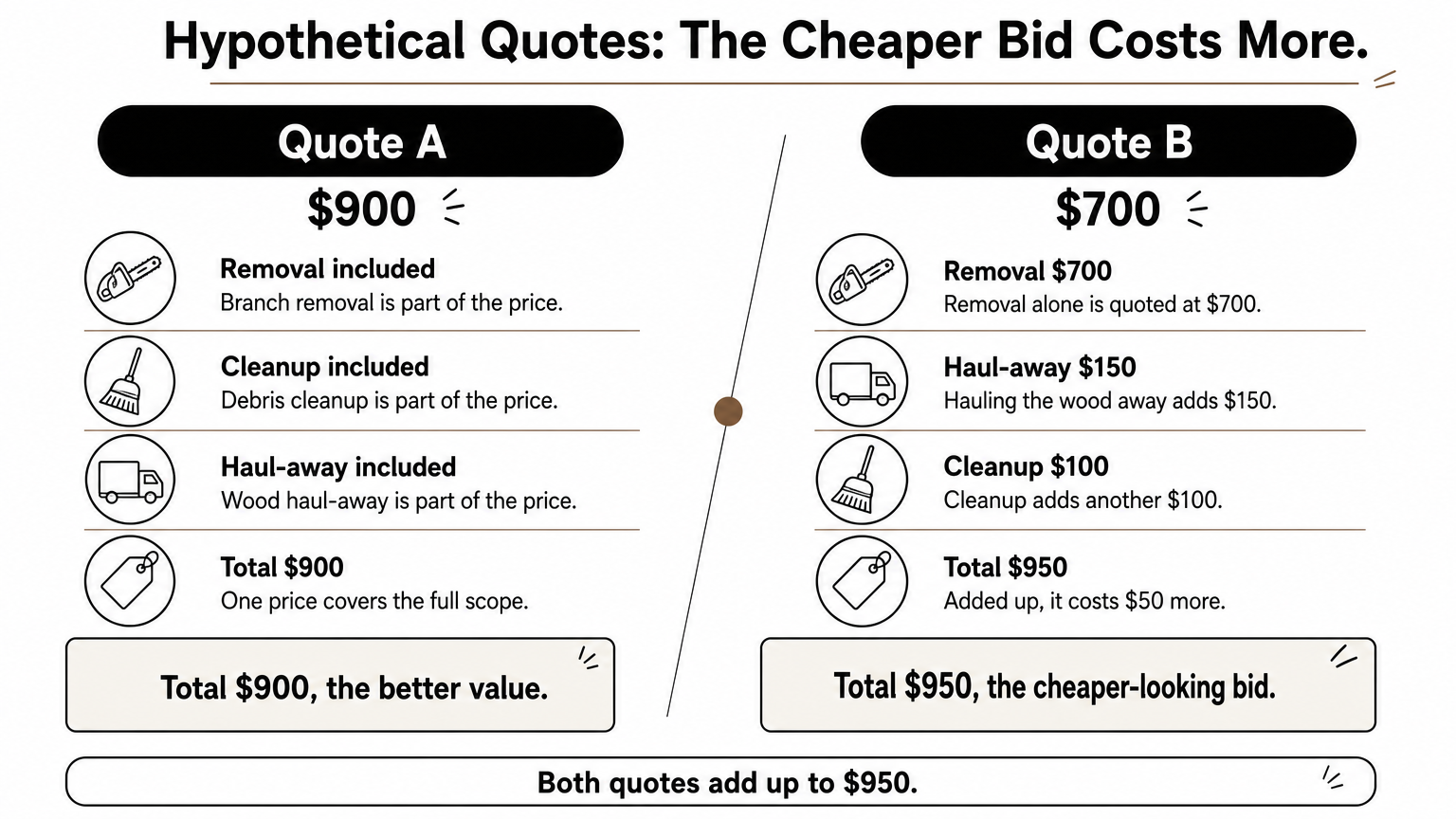
Ask every provider whether the estimate is free, what is included, and whether the price is fixed or can change on the day. An unusually low bid deserves a question about insurance before you say yes.
Compare totals with the same scope, not the first number on the page.
Step 3. Vet the provider before you book
Anyone can post a truck wrap and a phone number, so verify the basics before anyone touches your tree. The checks take about 10 minutes per company.
Credentials to verify
Ask for these items in writing:
- ISA Certified Arborist credential, with a certification number you can check on the International Society of Arboriculture's website
- Liability insurance and workers' compensation coverage, with certificates sent from the insurer or agent
- Pruning to ANSI A300 standards , which means no topping and clean cuts
- A local address and phone number, not only a lead-form website
For reference, ArboBella's arborist holds ISA certification FL-295224A, and the company is licensed, insured, and a member of the ISA Florida Chapter and the North Port Chamber of Commerce. Hold every company you call to the same standard.
Red flags to walk away from
Be wary of door-knockers who appear after a storm, anyone who asks for full payment up front, and any crew that wants to top your tree. Topping cuts large limbs back to stubs, stresses the tree, and creates weak regrowth. A company that recommends removal without explaining why is another warning sign.
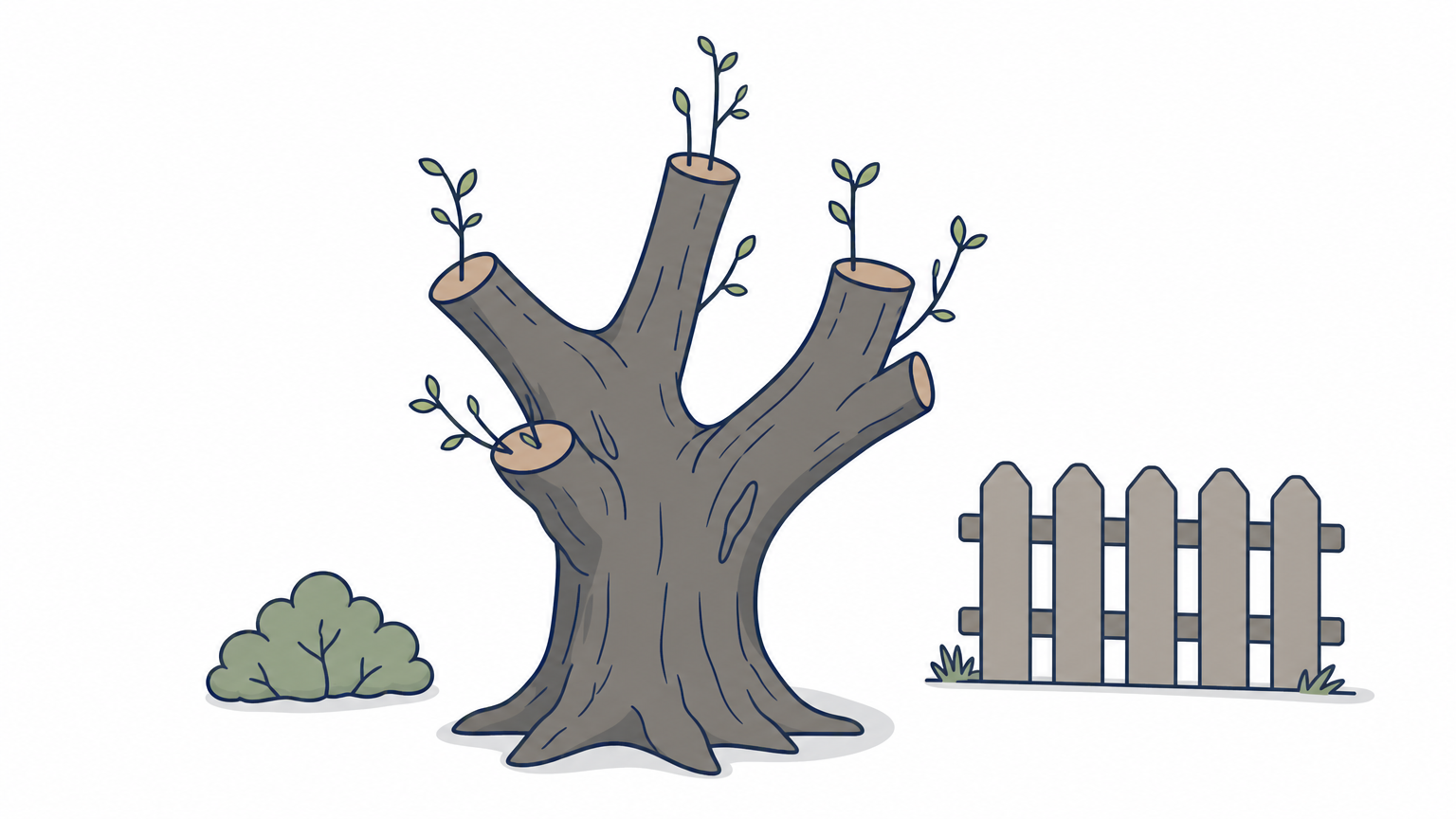
A good provider looks at the tree's health, structure, and site conditions first, and preserves healthy trees whenever practical. That approach protects both your property and your budget.
Verify insurance and credentials yourself, because a verbal promise covers nothing when a limb lands on your roof.
Step 4. Book the job and prepare the site
Once you pick a provider, confirm the scope in writing and prepare the property so the crew can work safely and quickly. A little prep also keeps the final bill from growing.
Send a clear request
Use this message when you ask for a quote. Fill in the brackets and attach your photos.
 Hello, I need a written estimate for tree work at [address].

Job: [remove limbs over roof / remove one large tree / remove a dead tree]
Tree: about [height] ft tall, trunk about [diameter] inches wide
Nearby: [house, pool cage, fence, power lines on the east side]
Access: [driveway, gate width, backyard or front yard]

Please confirm:
1. Is the estimate free, and is the price fixed?
2. Is cleanup and haul-away included?
3. Are you ISA Certified, and can you send proof of insurance?
4. Earliest available date?
Prepare for the work day
Move vehicles, patio furniture, and anything breakable out of the work zone. Mark sprinkler heads and irrigation lines, and keep children and pets indoors. Decide ahead of time whether you want the wood and chips left or hauled away , and whether you want the stump ground.
Do a walkthrough when the crew finishes. Check for cleared debris, lawn damage, and any limbs still hanging. Pay only once the work matches the written scope.
A written scope and a short walkthrough prevent most disputes before they start.
Your next step
Good branch, large tree, or dead tree removal comes down to four moves: describe the job precisely, understand what shapes the price, verify credentials and insurance, and put the scope in writing. Do those, and you can compare quotes fairly and avoid paying for work your tree does not need.
If you are in North Port, Port Charlotte, or Venice, you can talk to an ISA Certified Arborist at ArboBella Tree Service about your trees. You can also call 941-932-1768 and describe what you see.