Tree Cut Service Near Me: 6 Pros to Compare in SW Florida
If you're searching for a tree cut service near me in Southwest Florida, hire a licensed, insured company with a certified arborist who inspects the tree before quoting. That is the safest choice for removal, large trimming jobs, and any tree near a house, pool cage, or power line. Landscapers can handle small ground-level trimming. Your electric utility or city may cover trees on power lines or public land at no charge. A cheap independent chainsaw crew only fits low-risk work, and only with proof of insurance.
The hard part is that every tree company looks alike online, and quotes for the same job can differ by hundreds of dollars. A low number often hides missing insurance, no cleanup, or a crew that tops a healthy tree because it is faster than pruning it properly. Storm season adds pressure, since demand climbs fast once a hurricane watch goes up. This guide compares six kinds of local providers, then covers costs and how to vet any company.
It comes from ArboBella Tree Service, a family-owned company in North Port that serves North Port, Port Charlotte, and Venice. It is listed first because it fits many jobs, but every option gets an honest look, including the cases where you do not need a tree company at all.
1. ArboBella Tree Service
ArboBella Tree Service suits homeowners and commercial clients who want a diagnosis before a cut. It is a local, certified arborist company that treats removal as one option among several.
What they do
ArboBella Tree Service is a family-owned company based in North Port with more than 10 years of industry experience . It offers residential and commercial tree cutting across North Port, Port Charlotte, and Venice, from a single overhanging limb to a full removal after a storm. The services include:
- Tree trimming and pruning, including clearance around roofs, driveways, and other parts of the property
- Tree removal for dead, declining, damaged, or hazardous trees
- Stump grinding (the underground root system is generally not excavated)
- Emergency services for fallen trees, hanging limbs, and split trunks
- Storm cleanup and debris removal
- Commercial removal, trimming, and emergency response for businesses, HOAs, municipalities, and property managers
Who it suits
Homeowners who are not sure the tree has to come down get the most from this option. The work is led by an ISA Certified Arborist (FL-295224A) who evaluates the tree's health, structure, location, and surroundings before recommending pruning, treatment, or removal. The stated aim is to preserve healthy trees whenever practical, so you hear about alternatives before you hear a removal price.
Businesses, HOAs, municipalities, and property managers also fit, because commercial work runs as its own service line with planned tree removals and clearance around buildings, parking areas, and walkways. Homeowners who need paperwork for an insurer can ask about tree-risk mitigation documentation , which comes with a final inspection by an ISA Certified Arborist after the recommended work is done. ArboBella does not promise that this earns a discount or coverage approval, and you should be wary of any company that does.
A good tree cut service tells you whether to cut before it tells you what the cut costs.
Cost and watch-outs
Pricing depends on the size, condition, and access of the tree, so ask for an estimate based on your property rather than expecting a flat rate. You can reach the company at 941-932-1768 or info@arbobellatreeservice.com.
Storm season stretches any local crew. Priority for qualifying preventive and storm work goes to customers in the annual tree risk protection program , subject to availability, so a non-member may wait after a major storm. Ask for the scope in writing, and confirm the license and insurance certificate as you would with any company.
2. Established local tree companies
Established tree companies are the right pick when the tree is big, tall, or close to something expensive and you already know it must go.
What they do
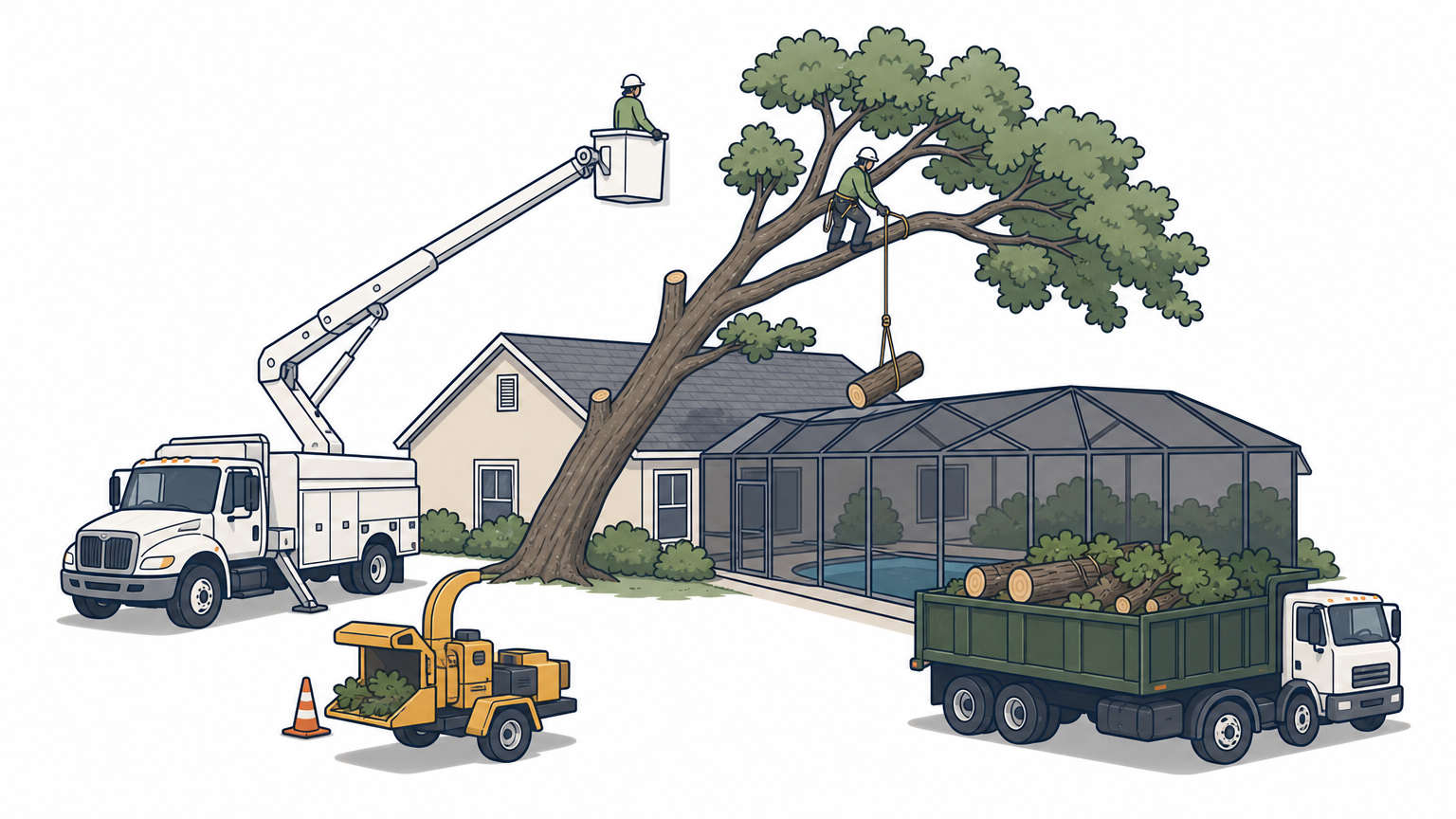
Full-service tree companies bring bucket trucks, chippers, and rigging gear to the job. They fell trees, trim crowns, grind stumps, and haul debris, often in a single visit. On site, expect:
- A climber or bucket truck to reach the crown
- Rope rigging to lower sections in pieces over roofs, fences, and pools
- A chipper for branches and a truck for logs
- A stump grinder, sometimes as a second visit
Who it suits
Big, awkward jobs belong here. A mature live oak leaning toward a roof, a pine over a pool cage , or several trees on one lot call for a crew that can rig sections down safely and work fast. Commercial grounds with many trees fit as well.
Choose a company in this group when you want a firm written quote for a removal you have already decided on. If you are unsure whether the tree can be saved, ask whether a certified arborist will inspect it. Not every tree company employs one.
Cost and watch-outs
Expect prices in the middle to upper part of the national ranges in the cost section below, because you pay for equipment, labor, and insurance. Quotes vary widely between companies, so compare scope and not just the total. Watch for these:
- Subcontracted crews you never met, so ask who will be on your property
- Phone estimates for large trees, which are guesses until someone sees the site
- Large deposits before any work starts
For a tree you cannot reach from the ground, equipment and insurance are what you are paying for.
3. Landscapers and lawn care companies
A landscaper works for small, low-risk trimming that you can reach from the ground, and not for anything that needs climbing.
What they do
Landscapers and lawn companies trim shrubs, hedges, and small ornamental trees as part of regular upkeep. Some cut small limbs and small trees with pole saws and ladders. Many lack climbing gear, rigging, or a chipper, so bigger work is usually subcontracted or declined . Typical jobs include:
- Shaping crape myrtles and other small ornamentals
- Trimming hedges and shrubs
- Removing low palm fronds and small dead branches
- Bagging and hauling the cuttings with the regular lawn visit
Who it suits
Homeowners with a few small trees and a landscaper they already trust get good value here. Bundling the cutting into your regular visit is convenient and usually the cheapest route for light work .
The line to draw is height and weight. If a worker has to climb, or a cut limb could land on a roof, fence, or line, hire a tree company. Bad pruning cannot be undone, and removing too much canopy can stress a tree for years.
A landscaper is the right call for what you can reach from the ground, and the wrong call for anything you would worry about dropping.
Cost and watch-outs
For small jobs a landscaper often costs less than a tree company, since there is no extra truck or crew. The catch is coverage. A general lawn-care policy may not extend to climbing or felling, so ask for proof of insurance that covers tree work . Before you agree, ask:
- Who does the cutting, your landscaper or a subcontractor?
- Does the insurance certificate cover tree work?
- Will they haul the debris, or leave it at the curb?
4. Your electric utility
Call the utility first when a branch is near an overhead power line. It is the one provider that may cut a tree for you at no charge.
What they do
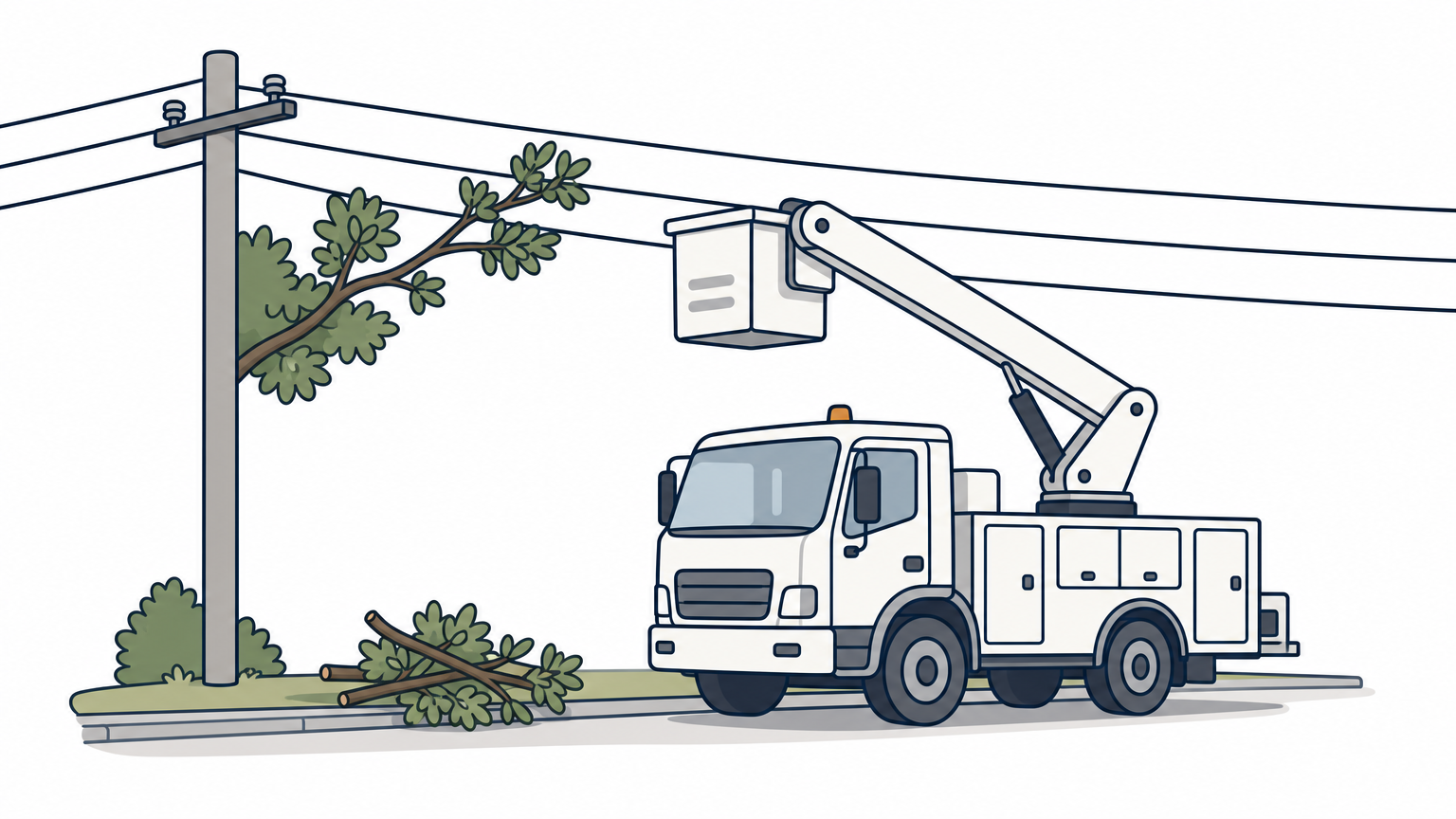
Your electric utility trims trees that touch or threaten its lines, usually at no cost to you for line clearance. It works to its own schedule and its own standard, which is keeping lines clear and not shaping the tree. In general:
- It covers branches growing into overhead power lines
- It usually does not remove whole healthy trees
- It does not handle trees that are hazardous for reasons unrelated to the lines
- It may leave cut wood on site
Who it suits
Anyone with a tree growing into overhead lines should call the utility before doing anything. Never trim near a line yourself, and do not hire a general crew to do it casually. Assume every wire is live, and keep well back. Ten feet is a common minimum distance for untrained people.
This is the closest thing to a free tree cut for qualifying trees. Contact customer service, describe the tree, and ask about timing. Only qualified line-clearance workers should work close to energized lines, and many general tree crews are not.
If the branch is near a wire, the call goes to the utility, not to a neighbor with a saw.
Cost and watch-outs
Line clearance is free but slow. After a hurricane, restoring power takes priority over routine trimming, so a non-urgent request can wait for weeks. Do not count on the utility for removal either, since anything beyond clearance is your cost.
Do not treat the utility as a free pass for general maintenance. A tree that is dead, split, or leaning toward your house for reasons unrelated to the lines is your responsibility , so call a tree company for it.
5. City, county, and HOA crews
Public works departments and HOAs can cut some trees for free, but only trees that are not on your own lot.
What they do
Cities, counties, and some HOAs maintain trees on public land and common ground , and many clear storm debris from the curb after major events. Programs differ by location, so check with yours. Typically:
- Trees in the public right-of-way are the city or county's job
- Trees on HOA common ground are the association's job
- Storm debris is collected during official cleanup periods
- Trees on your own lot are usually yours to handle
Who it suits
Residents whose problem tree stands in the right-of-way or on common ground should report it through the city or county request line, or the HOA manager. The tree may not be yours to cut, and cutting it yourself can bring fines or a dispute with neighbors.
Check the rules before felling your own tree too. Some Southwest Florida cities and counties require a permit for removing certain trees , and some HOAs want approval before a tree comes down on your lot. A reputable company will tell you whether your job needs a permit, and you can confirm with the city or county office.
Before you pay anyone to cut a tree, find out whose tree it is.
Cost and watch-outs
Work on public trees is free, but do not expect speed. Requests queue behind safety hazards, and storm season backlogs can stretch the wait. If a tree is an immediate danger to your home, call a tree company and sort out reimbursement later.
For HOA trees, read your covenants and ask in writing who is responsible. Getting the responsibility question answered in writing protects you if the tree causes damage later.
6. Independent chainsaw operators
An independent operator is the cheapest option and the riskiest. It fits only small ground-level jobs where you can verify insurance first.
What they do
Independent operators are one- or two-person crews, often found through flyers, truck signs, or social media, who cut trees at low prices . They answer quickly, especially after storms. Some are skilled and insured, and many are neither. Treat these as red flags:
- No certificate of insurance when you ask for one
- A large cash deposit, or cash-only payment
- Door-to-door offers right after a storm
- A plan to top the tree, which means cutting main limbs back to stubs and harms the tree's health
- No written estimate
Who it suits
Someone with a small, ground-level job, a tight budget, and the patience to verify credentials can make this work. Ask for the insurance certificate before the first cut , and check that the name on it matches the name on the truck.
For anything near a structure, skip this option. One bad drop can cost more than the savings, and the repair bill is yours if the crew has no coverage.
A quote that is far below the rest is usually missing insurance, cleanup, or skill.
Cost and watch-outs
Quotes come in lower because overhead is lower: no insurance, no workers' compensation, little equipment. You then carry the risk. If a worker is hurt on your property or a limb goes through your roof, you may be left to pay , depending on your homeowners policy.
If you still go this way, get the scope and price in writing, pay on completion and not upfront, and take photos before work starts. Compare it with a second quote from an insured company before you decide.
What tree cutting costs and how to pay less
The cost of cutting a whole tree down, which the trade calls tree felling, runs about $720 to $2,070 nationally, and trimming runs about $440 to $1,220. These are national averages from home-services marketplace data, so treat them as a frame for your quotes.
Typical price ranges
Use the table as a sanity check and not a promise. Florida prices shift with crew, access, and season, and storm work often costs more than routine work.
| Job | Typical national range | What pushes the price up |
|---|---|---|
| Tree removal (felling) | about $720 to $2,070 | Height, leaning, dead wood, nearby structures and lines |
| Trimming and pruning | about $440 to $1,220 | Tree size, canopy reduction, climbing required |
| Stump grinding | Quoted separately | Stump diameter, roots, tight access |
| Emergency and storm work | Usually above routine rates | Urgency, hazards, hours worked |
Price follows height, access, and risk, so a tall tree over a pool cage costs more than the same tree in an open yard.
A worked example for a 40-foot tree
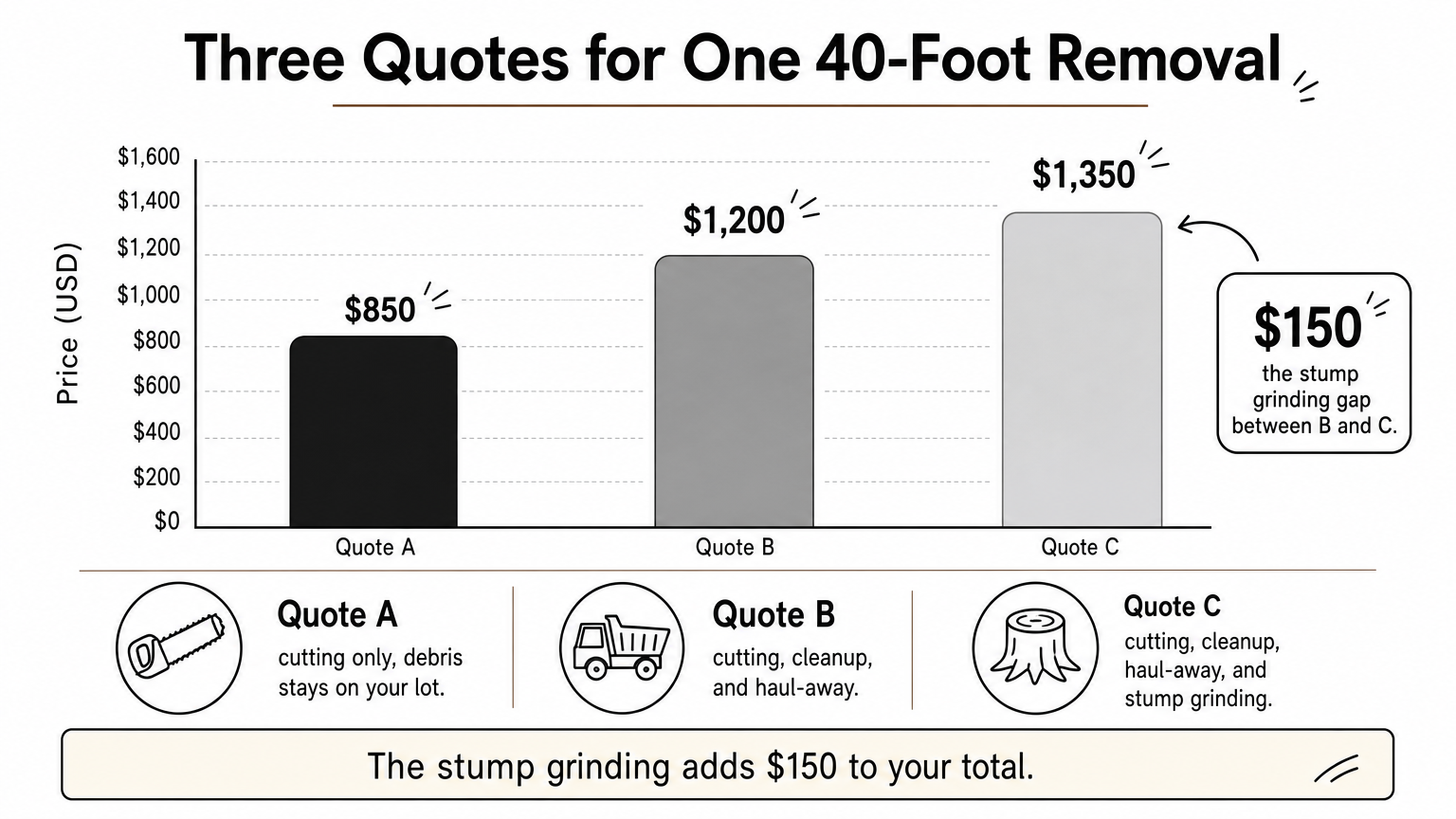
A 40-foot tree usually falls somewhere in the middle of the removal range , and higher if it leans over a structure. Suppose three companies quote the same removal. The figures below are illustrative, not market prices.
| Quote | Price | What it includes |
|---|---|---|
| A | $850 | Cutting only, debris stays on your lot |
| B | $1,200 | Cutting, cleanup, haul-away |
| C | $1,350 | Cutting, cleanup, haul-away, stump grinding |
Quote A looks $350 cheaper than B, but you would deal with the debris yourself, and a bare-bones quote is often a sign of thin insurance coverage . Between B and C, the stump grinding adds $150. If you want the stump gone, ask B what it would charge separately , because $150 is the number to beat.
When to book and how to pay less
Hurricane season runs June 1 to November 30, and crews fill up after any named storm. Book non-urgent cutting in the drier winter and early spring months, ideally before June , and you get better availability and more room to compare. Pre-season trimming also removes weak limbs before the wind tests them. To lower the bill:
- Get three written quotes with the same scope
- Bundle trimming, removal, and stump grinding into one visit
- Ask whether pruning can save the tree, since it costs less than removal
- Keep the wood chips if you can use them as mulch
- Call your insurance agent before hiring if a storm dropped the tree on a structure, since coverage depends on your policy
Truly free tree cutting only comes through the channels above: your utility, public works, or an HOA. Treat an unsolicited offer of free removal from a door-to-door crew as a warning sign.
How to vet a local tree cutting service
Check four things before you book anyone: credentials, insurance, reviews, and a written scope. Ten minutes of checking screens out most bad options.
Credentials and insurance to verify
Credentials are the one area where you can verify claims and not just trust them. A company that hesitates to share them has answered your question. Ask for:
- ISA Certified Arborist credential: get the certification number and look it up in the ISA's online directory
- Liability insurance: request a certificate, ideally sent directly from the insurance agent
- Workers' compensation: it protects you if a crew member is hurt on your property
- Local license or registration: ask what your city or county requires, and who pulls any removal permit
Verify the insurance certificate yourself, because a promise to be insured costs nothing.
How to read reviews and compare quotes
Start with the company's Google Business Profile and read the two- and three-star reviews first . Look for patterns: property damage, missed appointments, surprise charges, or debris left behind. Favor recent reviews from your area, owner replies that stay calm, and before-and-after photos of real jobs.
Then line up the quotes on scope. Matching scope matters more than matching price : what is being cut, whether cleanup and haul-away are included, whether stump grinding is in or out, and how the crew will protect your roof, fence, and pool cage.
Questions to ask before you book
A short phone call reveals a lot about how a company works. These questions separate careful crews from the rest:
- Will a certified arborist assess the tree, or only a salesperson?
- Is cleanup and haul-away included in the price?
- Is stump grinding included, or a separate charge?
- Who handles the permit if one is needed?
- How will you protect nearby structures during the cut?
- When is payment due, and is a deposit required?
Pick the pro that fits the tree
The right tree cut service depends on the tree. Use your utility for branches near power lines, public works or your HOA for trees on common ground, a landscaper for small reachable trimming, and an insured, certified arborist company for everything with real risk. Keep the independent operator for the smallest jobs, and only after you see proof of insurance.
Whoever you call, get three written quotes with the same scope and verify credentials before the first cut. If you want a certified arborist to look at your tree and tell you whether it needs cutting at all, talk to a certified arborist at ArboBella Tree Service about a tree removal evaluation.