Pricing for Tree Removal in SW Florida: What to Expect
Pricing for tree removal in the United States usually falls between $200 and $2,000 per tree, with national averages clustering around $630 to $750. Height drives the base price at roughly $10 to $14 per foot. Access, tree condition, emergencies and cleanup then move the final number up or down. Cost guides that break out Florida put a typical job at $750 to $1,500, so budget toward the upper half of the national range.
In plain terms, tree removal pricing is what a tree service charges to cut a tree down safely, section it and clear it from your property, plus add-ons like stump grinding or hauling. It is a quote built from labor, equipment, risk and disposal, not a flat rate. That is why two neighbors can pay very different amounts for trees that look alike from the street.
This guide explains why prices vary, how height and size set the base cost, which site conditions add to it, how to read a quote line by line, and how to lower the bill without cutting corners. It is written for homeowners and property managers in North Port, Port Charlotte and Venice, where ArboBella Tree Service, a family-owned certified arborist company, handles removals.
Why tree removal pricing varies so much
What most homeowners pay
Most homeowners pay $200 to $2,000 per tree , and the middle of the market sits near $630 to $750 . Narrower estimates put typical jobs at $385 to $1,070. The extremes are real, though. A very small, easy tree can cost about $150, while a large tree wedged between a roof and power lines can reach $10,000.
| Benchmark | Typical figure |
|---|---|
| Average cost per tree | $630 to $750 |
| Common range | $200 to $2,000 |
| Narrower typical range | $385 to $1,070 |
| Per foot of tree height | $10 to $14 |
| Low end (small, easy tree) | about $150 |
| High end (large, complex job) | up to $10,000 |
| Florida typical job | $750 to $1,500 |
Florida pulls the numbers upward. Cost guides that break out the state show $750 to $1,500 for a typical removal, which sits above the national middle. Big spreading oaks, heavy palms and storm-season demand are common reasons local quotes land high. Use the national figures as a floor for your budget , not a ceiling.
Why one average hides a wide spread
Tree removal is priced by risk and labor, not by the tree itself. A 20-foot tree in an open yard takes one climber a couple of hours. A 90-foot tree beside a pool enclosure needs rigging, a ground crew and sometimes a crane. Mid-sized trees typically take four to eight hours, and very large ones can take one to two full working days. The service has the same name in every case, but the jobs are completely different.
That is why a national average works only as a starting point. It blends easy jobs with hard ones. Your number depends on height, trunk, access and what happens to the wood afterward, and the next sections take those one at a time.
A tree removal average is only a starting point, because height, access and cleanup decide where your quote lands.
Why the lowest quote can cost the most
A quote far below the others usually has something missing, such as liability insurance , cleanup or the experience to drop limbs where they belong. If an uninsured crew damages your roof or someone gets hurt, the cost can land on you. Before you compare prices, confirm three things with every tree removal company:
- Proof of current liability insurance and workers' compensation coverage
- A written scope that says what is removed and what is left behind
- The name of the person who will supervise the work on site
Pricing by tree height and size
Typical prices by height
Height is the biggest input in pricing for tree removal, because taller trees need more climbing, more rigging and more time on site. Published ranges for 2026 line up closely across sources and look like this.
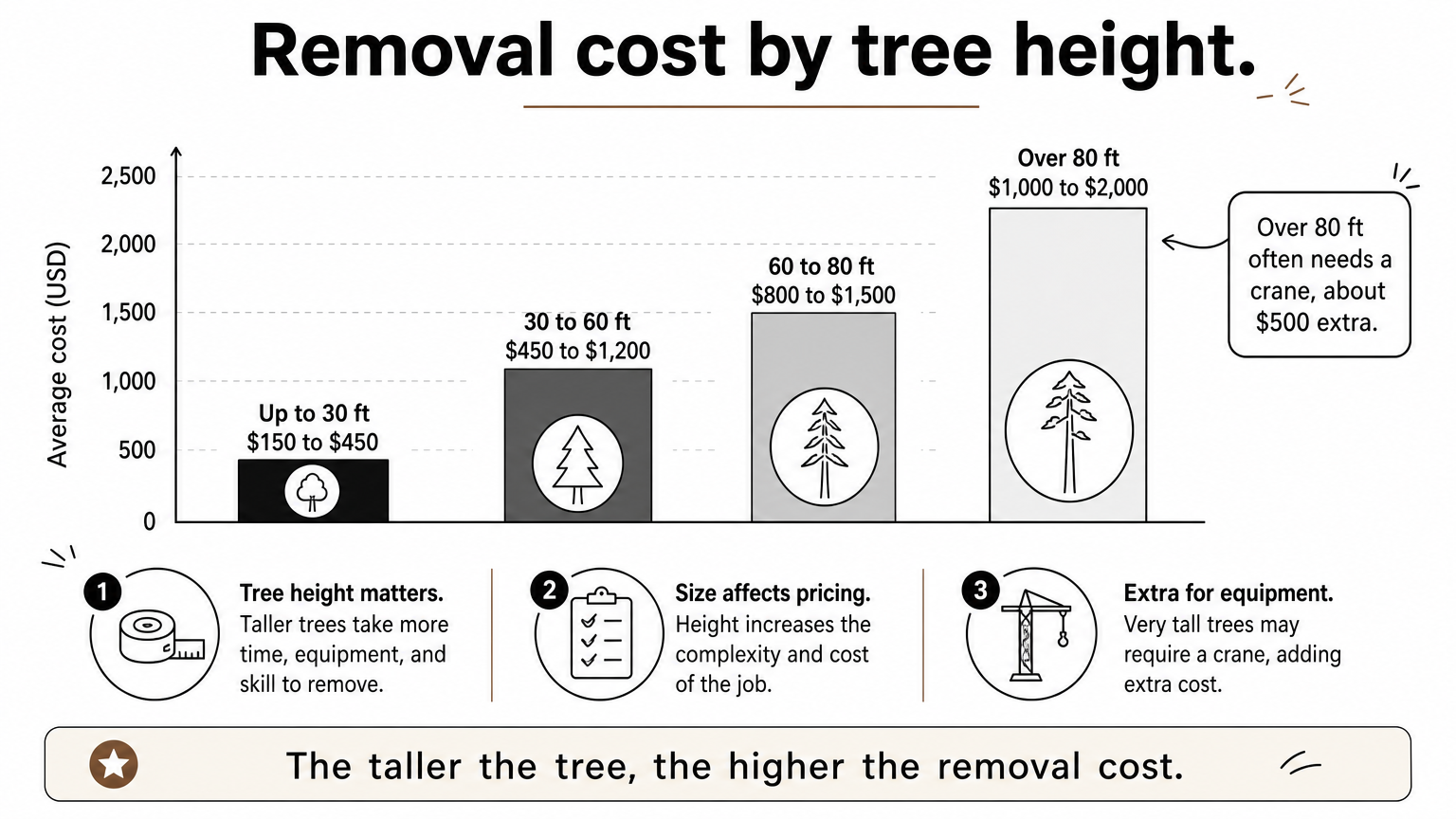
| Tree height | Typical price | What changes at this size |
|---|---|---|
| Up to 30 ft | $150 to $450 | Often one climber, a few hours |
| 30 to 60 ft | $450 to $1,200 | Climbing and sectioning, four to eight hours |
| 60 to 80 ft | $800 to $1,500 | Heavier rigging, larger crew, possibly a full day |
| Over 80 ft | $1,000 to $2,000 | Often a crane (about $500 extra), one to two days |
Treat these brackets as soft. Companies define size differently , and some call anything under 25 feet small and anything over 100 feet extreme. Ask each company how it measures the tree, and compare quotes for the same height and the same scope.
What a 30 ft, 40 ft or $1,000 tree means
A 30-foot tree sits at the top of the small bracket, so expect a quote near $450 or less on an open lot. Per-foot math agrees. Thirty feet at $10 to $14 comes to $300 to $420.
A 40-foot tree works out to $400 to $560 at the same per-foot rate. The bracket table starts at $450, so a quote between $400 and $600 is in line for an easy 40-foot tree. Stump grinding and haul-away come on top of that.
What does $1,000 buy? Usually a tree in the 50 to 80 foot range , or a smaller tree with a tight drop zone. If a $1,000 quote arrives for a 25-foot tree in an open yard, ask exactly what the scope includes.
Trunk width, species and palms
Trunk diameter normally scales with height, so it rarely changes the price on its own. The exception is a short tree with an unusually thick trunk, which takes longer to cut. Species matters less than size , although some trees are harder to take apart. Spreading oaks need extra rigging, and palms are heavy, which makes them expensive for their height.
| Tree type | Typical removal cost |
|---|---|
| Pine | $250 to $1,500 |
| Palm | $650 to $1,500 |
| Oak | $200 to $2,000 |
Those oak and pine ranges are wide because the same species can be a 25-foot yard tree or a 90-foot giant. Read species figures as a hint about how hard the tree is to dismantle , not as a price list.
Size sets the base price, and species matters only when it changes how hard the tree is to take apart.
Site conditions that raise or lower the price
Access, power lines and equipment
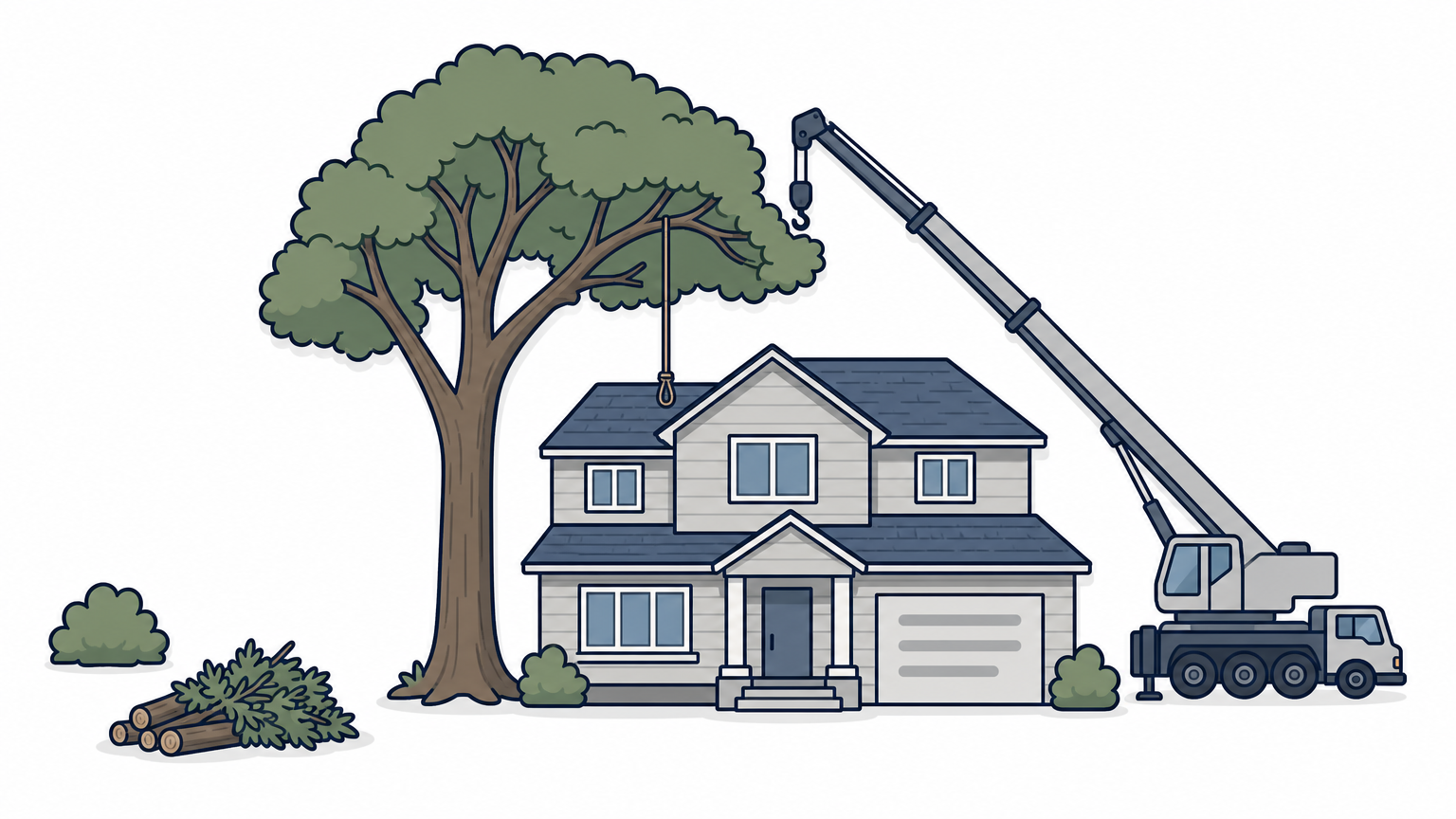
Tight access adds 25% to 50% to a removal bill. A tree beside a house, fence, pool cage or power line cannot simply be felled. The crew takes it down in small pieces, which takes longer and demands more skill. Equipment adds its own line items.
| Factor | Typical added cost |
|---|---|
| Tight access, structures or power lines nearby | +25% to +50% |
| Crane, per day | $250 to $600 (about $500 typical) |
| Crane-heavy, difficult removals (total) | $6,000 to $7,000 at the extreme |
| Emergency or storm-rush premium | Totals up to $5,000 |
Here is a worked example. Take a 65-foot tree beside a house with a base bracket of $800 to $1,500. A 25% to 50% access premium makes it $1,000 to $2,250 . If the crew also needs a one-day crane at about $500, the range becomes $1,500 to $2,750 before stump grinding or cleanup.
Height sets the base price, but the space around the tree decides how much you add to it.
Tree condition, fallen trees and storm calls
A dead or diseased tree is not automatically cheaper. Brittle wood can be easier to cut, and removals of this kind are reported around $400 to $900 . A weak tree may also need extra support and specialized rigging to come down safely, and that erases the savings. Have a certified arborist inspect it before you assume either outcome.
A tree that has already fallen is the cheap case, typically $75 to $300 , since the crew skips the climbing and just cuts and hauls. Emergency removal work is the opposite. Right after a storm, demand spikes and prices can reach $5,000 depending on danger and time on site. In Southwest Florida that matters from June through November, during hurricane season.
If a tree has hit your home, photograph it and call your insurer before anyone removes it. An adjuster may need to see the damage first, and early removal can erase evidence. Tell the crew about the claim so they can document their work.
Permits and local rules
Many municipalities require a permit to remove a tree above a certain size. Permits typically cost $60 to $150 . If the city also requires an arborist report, budget about $860 more. Rules differ by city and county, so confirm with your local government before work starts, or ask the tree service whether a permit applies to your tree.
Florida also limits what local governments can require for residential trees. Under state law, an owner who has documentation from an ISA Certified Arborist that a tree presents a danger to people or property can generally remove it without a local permit or fee. That rule covers residential property, so commercial sites and HOA-managed grounds may follow different requirements. Confirm how your jurisdiction applies it before you rely on it.
How to read and compare a tree removal quote
What a complete quote includes
A good removal quote is itemized. It names the tree, the method, and exactly what is left when the crew drives away. Look for these lines:
- Which trees are included and where they stand on the property
- The removal method, and whether a crane or bucket truck is needed
- Cleanup: hauling, chipping, or leaving the wood on site
- The stump: ground down or left in place
- Who pulls the permit, if one is required, and who pays for it
- Proof of liability insurance and a scheduled start date
- The total price, payment terms and what happens if the scope changes
Cleanup is the line most often missing. Some companies include debris removal, while others charge extra. These add-ons are common.
| Add-on | Typical cost |
|---|---|
| Stump grinding | $100 to $450 per stump |
| Debris hauling | $50 to $90 |
| Chipping | $65 to $125 |
| Splitting into firewood | $50 to $90 |
Grinding out a stump takes it down below grade, but it generally leaves the underground root system in place. Say so in the quote conversation if you plan to replant in the same spot.
A quote is only comparable when every company prices the same height, the same cleanup and the same stump decision.
A worked example with every line added
Take an easy 40-foot tree on an open lot, with the stump ground and the debris hauled away. Each line comes from the ranges above.
| Line item | Low | High |
|---|---|---|
| Removal (40 ft at $10 to $14 per foot) | $400 | $560 |
| Stump grinding | $100 | $450 |
| Debris hauling | $50 | $90 |
| Total | $550 | $1,100 |
If your city requires a permit, add $60 to $150, which brings the total to $610 to $1,250 . Keeping the wood and leaving the stump takes you back toward the base figure. That spread of $550 to $1,100 for one ordinary tree shows why the line items matter more than the headline price.
Credentials worth verifying
Choose a company led by an ISA Certified Arborist , a credential earned through training with the International Society of Arboriculture. You can check it with the ISA. ArboBella Tree Service, for example, is led by an ISA Certified Arborist (FL-295224A), is licensed and insured, and evaluates each tree's health, structure and surroundings before recommending pruning, treatment or removal.
Then do the basics. Get at least three written quotes for the same scope, and sign a written contract before work begins. Ask for references from neighbors or recent customers, and read public reviews. A company that welcomes these questions is usually one you can trust on the day the saw starts.
How to lower the bill without cutting corners
Confirm the tree really needs to come down
The cheapest removal is the one you do not need. An arborist can tell you whether pruning or treatment will do the job, and tree trimming usually costs $200 to $760 , far less than removal plus replanting. A good evaluation also protects you from paying to remove a healthy tree.
Removal is usually justified when the evidence is clear:
- The tree leans more than 15% from vertical
- More than 25% of its branches are dead or damaged
- The trunk is hollow, rotting, or shows fungus at its base
- More than half of the root system is damaged
- It threatens a home, roof, or power line
Pay for an arborist's opinion first, because a correct diagnosis can save the entire removal cost.
Time the job and bundle the work
For trees that are not urgent, schedule in the off-season . Late winter and early spring are the cheapest windows in many regions because crews are less busy, and in Florida you should book well before the June start of hurricane season. After a storm, everyone calls at once and emergency premiums rise.
Bundle your work. Removing several trees in one visit spreads the crew's travel and setup over more cuts, and it gives you room to negotiate. Smaller savings add up as well:
- Clear fences, planters and yard ornaments from the work area beforehand
- Keep the logs for firewood instead of paying for hauling
- Leave the stump if you do not plan to landscape the spot
- Gather three quotes so you can see what is normal for your tree
Check insurance and think twice about DIY
Homeowners insurance may cover removal when a storm brings a tree down, depending on the cause and whether it damaged your home. Read your policy before you pay out of pocket , and keep photos and invoices. ArboBella Tree Service provides documentation of completed tree-risk mitigation for your insurance agent to review, but it does not guarantee any discount, premium reduction or coverage decision.
Doing it yourself rarely pays. Equipment for a small tree can run around $425 if you own none of it, while a professional charges roughly $150 to $385 for a small tree. Larger trees carry serious injury and property risk , and any damage is your responsibility. Leave anything that needs a ladder or sits near a structure to a crew.
Getting a fair price on tree removal
Tree removal pricing comes down to a few levers. Height sets the base price at roughly $10 to $14 per foot. Access, tree condition, urgency and permits adjust it, and stump grinding and cleanup are separate lines. In Southwest Florida, plan for the upper half of national ranges, and treat any quote you cannot itemize as incomplete.
The practical path is simple. Have a certified arborist confirm that the tree needs to go, ask for an itemized written quote, and compare it against the figures in this guide. If you want a local evaluation in North Port, Port Charlotte or Venice, you can ask ArboBella Tree Service's tree removal service to assess your tree and quote the work.