
How to Remove a Tree Stump Yourself: DIY Methods Compared
A stump in the middle of your yard is more than an eyesore. It traps mower blades, invites termites and carpenter ants, and sprouts suckers that never quit. If you searched stump removal how to , you probably want to fix it yourself and keep the money a grinding crew would charge.
You can, but the right method depends on the stump. Digging and chopping out works best on small stumps with shallow roots, and usually takes a few hours. Chemical or Epsom salt treatments cost little but take months, and they rarely finish the job alone. Rental grinders and burning sit in between, with their own safety and permit concerns.
Below, we compare each DIY method on cost, time, effort, and risk, with step-by-step instructions. Our ISA Certified Arborist has handled stumps across North Port, Port Charlotte, and Venice for over 10 years, so we also flag Florida-specific issues like sandy soil, fast regrowth, and when DIY stops making sense .
Before you start: pick the right method
Picking a method first saves you a wasted weekend. Most failed DIY stump jobs happen because someone brought a shovel to a 30-inch oak, or poured Epsom salt on a stump they needed gone by Saturday. Your stump diameter and your deadline narrow the options fast.
Compare the methods side by side
Here is how the common stump removal methods stack up. The ranges below are typical equipment and supply costs , not labor, and the times assume one person working with basic tools.
| Method | Best for | Typical cost | Time | Effort | Main risk |
|---|---|---|---|---|---|
| Dig and chop by hand | Under 12 in., shallow roots | $0 to $60 in tools | 2 to 6 hours | High | Back strain, hidden pipes |
| Rented stump grinder | 12 to 24 in. | $150 to $400 per day | 2 to 4 hours | Medium | Flying debris, blade contact |
| Epsom salt or stump remover | Any size, if you can wait | $10 to $30 | 3 to 12 months | Low | Slow, often incomplete |
| Burning | Fully dry, dead stumps | Under $20 | 1 to 3 days | Medium | Fire, local burn rules |
| Winch or excavator | 24 in. and larger | $200 to $500 rental | 3 to 6 hours | High | Equipment failure, injury |
Three questions that decide it
Answer these before you buy or rent anything. Together they point to one or two realistic options.
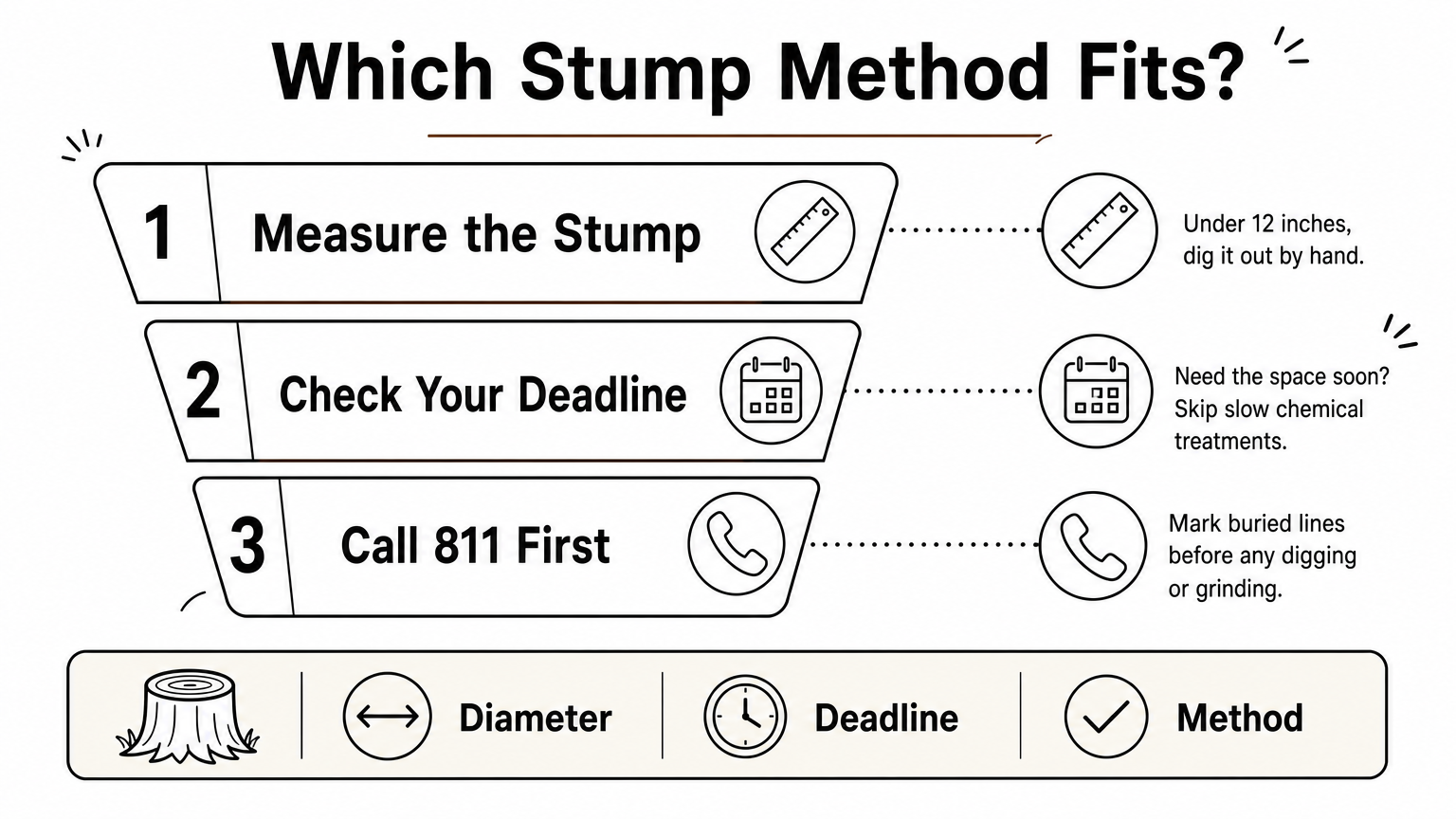
- How wide is the stump? Measure across the cut surface. Under 12 inches, you can dig it out. From 12 to 24 inches, a grinder pays off. Beyond that, you need a winch, an excavator, or a pro.
- How soon do you need the space? If you plan to lay sod, build a patio, or sell the house this season, skip the slow chemical route.
- What is underground nearby? Septic lines, irrigation, and buried cable all sit in the same top two feet where roots live. Call 811 a few days before any digging or grinding.
This is the point most guides skip, and it matters more than the price tag.
Your stump's diameter and your deadline pick the method for you, so measure and decide before you spend a dollar.
Florida factors to weigh
Soil changes the job. Sandy Southwest Florida soil drains fast and holds roots loosely, so digging goes quicker here than in clay country. The tradeoff is that roots run shallow and wide, which means more of them to cut. Palm stumps are a different animal entirely. They have no taproot, just a dense fibrous mass, and you can often dig them out in an afternoon.
Regrowth is the other local issue. Live oak, Brazilian pepper, and many other species resprout aggressively in our warm, wet summers. If you choose a method that leaves roots alive, such as grinding without follow-up, plan to treat the sprouts as covered in Step 7. Also check with your local fire department before you consider burning. Many Florida municipalities restrict it, and dry-season burn bans are common.
Step 1. Assess the stump and gather safety gear
Ten minutes of inspection decides whether the rest of this job goes smoothly. Before you swing a mattock or rent anything, look at what you are actually dealing with and make sure you have the protection to do it. Any stump removal how to plan that skips this step ends up costing more.
Inspect the stump and the site
Start with a tape measure. Record the diameter across the cut surface and the height above ground, since both decide which method from the table fits. Then push a flathead screwdriver into the wood. If it sinks more than an inch, the stump is already rotting and digging will go faster than you expect.
Run through this quick checklist before you move on:
- Species: Palm stumps dig out easily. Oak and ironwood fight back.
- Live sprouts: Green shoots mean living roots that will need follow-up treatment.
- Obstacles: Note fences, foundations, sidewalks, and sprinkler heads within 10 feet.
- Slope and footing: Wet sand and uneven ground make a pry bar dangerous.
Next, deal with what is underground. Call Sunshine 811 at least two full business days before you dig or grind, and mark the locations they flag. The service is free, and hitting a buried line costs far more than any rental.
Call 811 before you touch the ground, because a hidden line turns a weekend project into an emergency repair.
Gather your safety gear
Stump work throws chips, dirt, and rock fragments at your face, and it puts blades and sharp tools near your legs. Wear full protective gear every time, even for a short job. The table below covers what each method needs.
| Item | Why you need it | Needed for |
|---|---|---|
| ANSI-rated safety glasses or face shield | Flying chips and soil | All methods |
| Hearing protection | Grinders and saws exceed safe noise levels | Grinder, chainsaw |
| Leather gloves | Blisters, splinters, cuts | All methods |
| Steel-toe boots | Dropped tools, slipping blades | All methods |
| Long, heavy pants or chainsaw chaps | Debris and blade kickback | Grinder, chainsaw |
| Dust mask | Fine wood dust and dry sand | Grinder, burning prep |
For tools, a mattock, round-point shovel, and root-cutting axe handle most small stumps. Add loppers and a pruning saw for thinner roots. Finally, bring a helper. Nobody should run a grinder or winch alone, and a second person can shut things down fast if something goes wrong.
Step 2. Cut the stump and prep the site
Most stumps need a trim before any method will work. A tall, ragged stump blocks a grinder and hides the roots you need to cut. Ten minutes with a saw sets up everything after it, and the right cut height depends on your method . Any good stump removal how to plan starts here.
Cut the stump to the right height
Use this table to pick your target before you pull the starter cord.
| Method | Cut height | Why |
|---|---|---|
| Hand digging | 6 to 12 in. | Enough wood to grip, short enough to dig around |
| Rented grinder | 2 to 4 in. | Gives the wheel a flat, clean starting surface |
| Winch or pulling | 3 to 4 ft | Works as a lever and a chain anchor |
| Epsom salt or remover | 6 in. or less | A fresh, flat cut absorbs treatment faster |
Cut the stump to the height your method needs, because the wrong height makes every later step harder.
Keep the chainsaw bar at least 2 inches above the soil . Dirt and sand dull a chain in seconds, and our Southwest Florida sand is especially abrasive. Make level cuts across the top, and wear chaps, eye protection, and hearing protection. If you lack a saw, a sharp pruning saw handles stumps under 6 inches, just slowly.
Prep the work area
Now clear the ground. A tidy site prevents most accidents , and it lets you see what the roots are doing. Work through this list in order:
- Clear a 10-foot radius of rocks, branches, toys, and hoses.
- Check that your 811 flags are still visible, and leave them in place.
- Scrape away mulch, sod, and loose soil around the base to expose the root flare , where the trunk widens into the roots.
- Spread a tarp beside the stump for soil, and park a wheelbarrow nearby for wood and roots.
- Keep kids and pets indoors, and keep bystanders at least 30 feet from a running grinder.
Finally, take a minute to look at what you exposed. Count the large surface roots and note which direction they run. That tells you where to dig first in Step 3, and it shows whether the stump is smaller than it looked.
Step 3. Dig out a small stump by hand
Hand digging is the cheapest stump removal how to method, and it suits stumps under 12 inches across with shallow roots. Plan on 2 to 6 hours of hard work. In Southwest Florida's sandy soil, roots run shallow and wide, so the job is mostly cutting roots , not moving dirt. Bring the mattock, round-point shovel, root-cutting axe, loppers, and pruning saw from Step 1.
Dig around and cut the roots
Work from the outside in. Start about 12 inches from the trunk and expose each lateral root before you cut it, so you never swing blind near a flagged line. Keep the tarp close for soil.
- Dig a trench 12 to 18 inches wide around the stump, about 12 inches deep, until you see where the main roots branch off.
- Follow each root outward with the shovel, then cut it 12 to 18 inches from the trunk.
- Use loppers for roots under 2 inches, the axe or mattock for mid-size roots, and a pruning saw for thick ones.
- Dig underneath to find any taproot, and sever it at the bottom with the axe or saw.
- Rock the stump back and forth after each cut. Movement tells you which roots still hold it.
Stop and clear the soil often. Chopping into packed sand dulls an axe fast, and a sharp blade saves your shoulders.
Lift it out and haul it away
Once the stump rocks freely, slide a pry bar or long shovel handle underneath and lever it upward. A 12-inch stump can weigh well over 50 pounds, so lift with a helper and bend your knees. Roll it onto the tarp and drag it, rather than carrying it, to the wheelbarrow.
If it will not budge, you missed a root. Dig deeper and find it.
Cut every root you can find before you pull, because forcing a stump out is how backs and tools break.
Finally, check the hole for leftover root pieces and pull out anything thicker than a pencil, since leftover roots can resprout. Many local haulers take yard waste, but check your municipal pickup rules for size limits before you stack it at the curb. Then jump to Step 7 to fill the hole and deal with regrowth.
Step 4. Grind it yourself with a rented grinder
Renting a grinder is the middle path in any stump removal how to comparison. It costs more than a shovel, but it turns a stump of 12 to 24 inches into chips in about 2 to 4 hours. You need the cut height from Step 2 and your safety gear from Step 1.
Pick and rent the right machine
Most equipment rental yards and home improvement stores offer a walk-behind stump grinder for $150 to $400 per day. A 13 horsepower model handles most residential stumps. Bigger or tracked units cost more and are harder to maneuver in a backyard. Ask these questions at the counter:
- Will it fit through my gate? Measure the opening first.
- Does it include a delivery option, or do I need a trailer?
- Can the staff show me the controls and the emergency stop?
Reserve early after a storm. Demand spikes, and the machines go fast.
Grind the stump in passes
Check the stump for nails, wire, and embedded rock first. Metal ruins a cutting wheel and can throw fragments. Then follow this process to grind a tree stump with your helper standing well back:
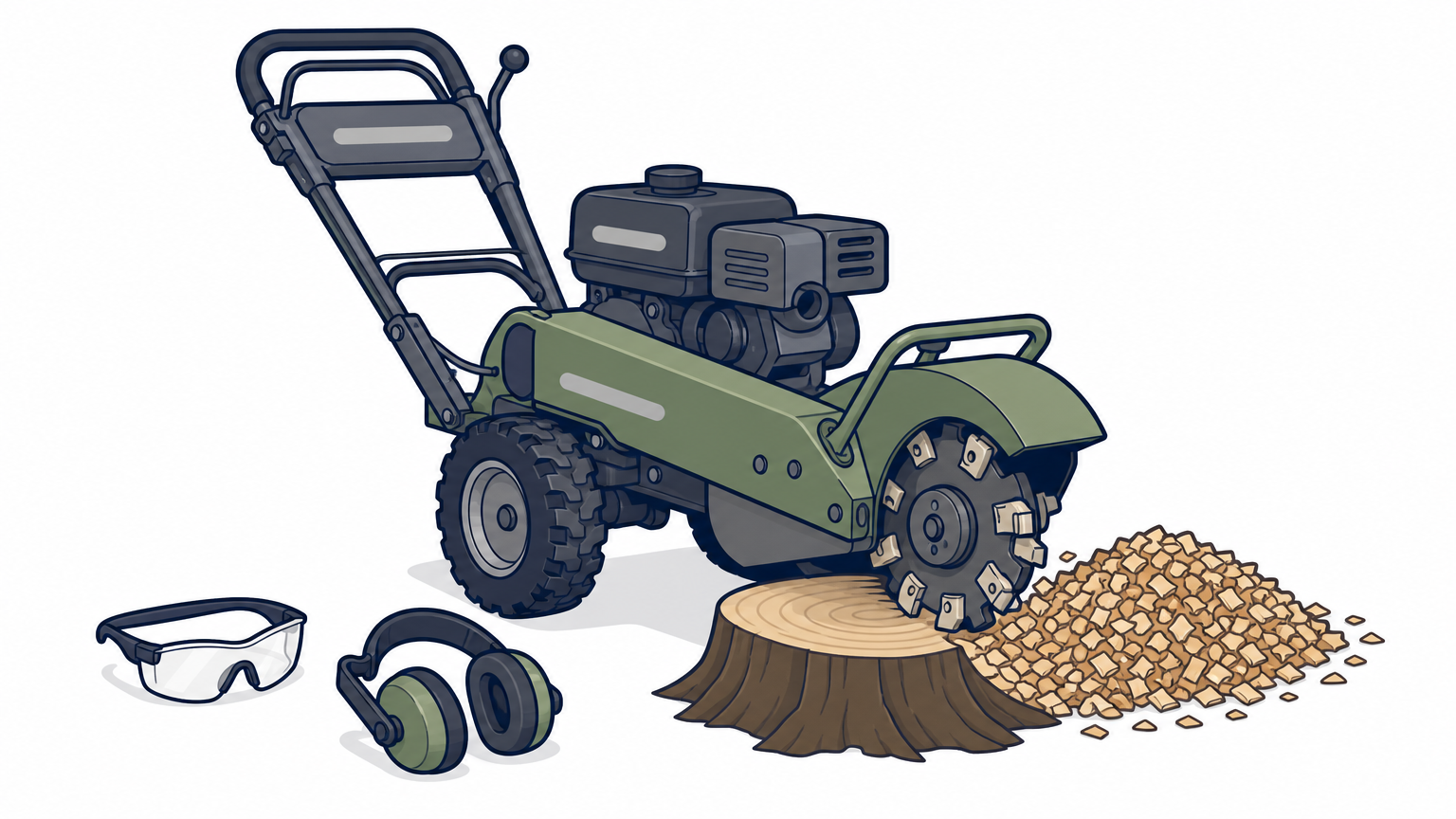
- Confirm the 811 flags are visible and put on glasses, hearing protection, boots, and chaps.
- Position the wheel just above the near edge of the stump, not touching wood.
- Start the engine, engage the wheel, and lower it about 1 inch into the stump.
- Sweep the wheel slowly from side to side in 2 to 3 inch passes.
- Lower the wheel 1 to 2 inches after each full pass and repeat.
- Grind to 6 to 8 inches below grade , then chase the larger surface roots outward.
Let the wheel do the cutting and sweep, don't shove, because forcing the machine is how it kicks and how people get hurt.
Shut the engine off and wait until the wheel stops spinning before you step near it. Never clear chips from a moving wheel.
Deal with the chips
A 20-inch stump leaves a surprising pile. Rake the chips into the wheelbarrow and reuse them as mulch around established trees and beds, no deeper than 3 inches. Fresh chips pull nitrogen from soil if mixed in, so never till them into a new lawn area.
Grinding kills the stump but not always the roots. Live species like oak and Brazilian pepper can resprout from leftover roots , so jump to Step 7 for fill and regrowth control.
Step 5. Speed up rot with Epsom salt or stump remover
Chemical methods ask for the least work and the most patience. They suit any size stump, as long as you can wait 3 to 12 months . Be realistic about the result. Treatment softens the wood so it breaks down, but it rarely removes the stump on its own. Think of it as the lazy half of a stump removal how to plan, with an axe finishing the job later.
Choose Epsom salt or a stump remover
Two products dominate the shelf. Here is how they compare.
| Epsom salt | Potassium nitrate stump remover | |
|---|---|---|
| Cost | $10 to $15 | $15 to $30 |
| How it works | Dries out the wood | Feeds fungi and softens the wood |
| Typical timeline | 6 to 12+ months | 3 to 6 months |
| Reliability | Inconsistent | Better, with regular refills |
We lean toward potassium nitrate when a client wants a chemical route. Epsom salt is cheap and gentle on the surrounding lawn, but its results vary a lot from stump to stump. Our wet Florida summers also dilute whatever you pour in.
Treat the stump
Start with a fresh cut, 6 inches tall or less, as set up in Step 2. Then work through these steps:
- Drill 1-inch holes about 8 to 10 inches deep, spaced 2 to 3 inches apart across the top.
- Angle a few holes into the sides so the product reaches the roots.
- Fill each hole with Epsom salt or stump remover granules.
- Add warm water to dissolve the granules, and stop just below the rim.
- Cover the stump with a tarp and weigh it down to keep rain out.
- Check every 3 to 4 weeks and refill any hole that has drained.
Drill deep, keep it covered, and refill often, because most chemical treatments fail from too little product and too little patience.
Finish the job once it softens
You will know it is ready when a screwdriver sinks in easily and the wood turns spongy or crumbly . Break it apart with an axe or mattock, then dig out the pieces as in Step 3. Rotted stumps come apart far faster than fresh ones.
Safety matters here. Read the label and keep kids and pets away from open holes. Do not use these products near vegetable beds or fruit trees. Skip anything labeled for burning unless your local fire department approves it, since many Florida areas restrict open fires.
Step 6. Winch or excavate large stumps safely
Stumps 24 inches and wider are where most stump removal how to advice turns dangerous. A 30-inch live oak stump with its root ball can weigh over a thousand pounds, so you are no longer lifting it. You are pulling it with a machine , and every chain, strap, and anchor has to be rated for the load.
Pull it with a winch or come-along
Use the 3 to 4 foot stump you left in Step 2 as a lever. Dig around it and cut the lateral roots first, as in Step 3, because a winch only works on a stump that is nearly free. Then rig the pull:
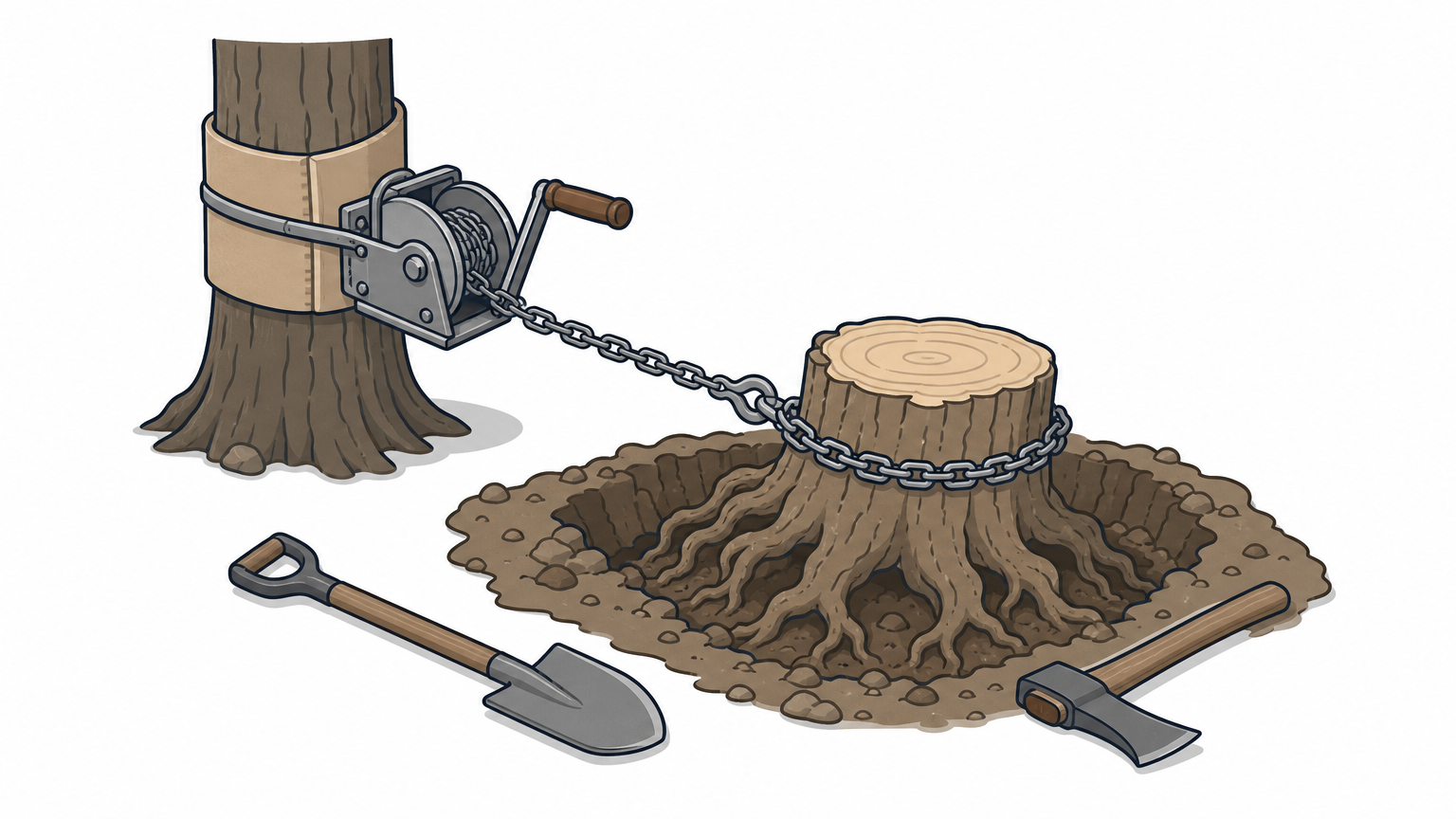
- Anchor a hand winch or come-along to a mature tree you are keeping, padded with a tree strap, or to a vehicle in park with the brake set.
- Wrap a rated chain around the stump as low as it will hold, but below the cut top so it cannot slip off.
- Take up the slack, then ratchet in short, slow pulls.
- Stop when tension spikes, dig down to find the root that is still holding, and cut it.
- Repeat until the stump tips out of the hole.
Never stand in line with a loaded chain, because a snapped line or hook whips back with enough force to kill.
Keep everyone off to the side during every pull. Choose gear with a working load limit well above your estimate of the stump's weight, and replace any chain that shows kinks or cracked links.
Use a rented mini excavator
A mini excavator rents for about $200 to $500 per day and finishes in hours what a winch does over a weekend. Ask the rental yard for a short walkthrough on the controls and the stability limits before you leave with it. Work on level ground, dig a trench around the stump with the bucket, then cut the exposed roots with an axe or reciprocating saw. Finally, rock the stump loose and lift it out.
Sandy Southwest Florida soil brings its own problem. Tracks can sink in wet sand , so lay sheets of plywood under the machine after a rainy spell. Keep it well away from septic tanks and drain fields, and recheck your 811 flags before the bucket touches dirt.
Be honest about your limits. If you have never run heavy equipment, or the stump sits near a foundation or utility line, hiring a pro is cheaper than one mistake. We cover that decision in the next section.
Step 7. Fill the hole and stop regrowth
Removing the wood is only two-thirds of a good stump removal how to job. An open hole collects water and twists ankles, and living roots left behind keep sending up shoots. This step handles both.
Fill the hole so it stays level
Start by pulling out any wood or root pieces thicker than a pencil. Buried wood rots and shrinks , which leaves a sinkhole a year later. If you ground the stump, scoop out most of the chips and use them as mulch, as covered in Step 4. Then rebuild the hole in layers:
- Fill with clean topsoil or a topsoil and sand mix, 6 inches at a time.
- Tamp each layer with the end of a 4x4 or with your boot.
- Mound the last layer 2 to 3 inches above grade.
- Soak it with a hose, then top off any spots that sink.
- Wait 2 to 4 weeks before laying sod or seed.
Sandy Southwest Florida soil drains fast, so water the patch daily for the first week or the new soil will wash and shift. Once it settles, you can plant over it.
Stop sprouts from coming back
Leftover roots are alive in many species. Live oak and Brazilian pepper can push shoots for years, even after you grind them. Cut every sprout at the base as soon as it reaches 6 inches. Each cutting drains the root's stored energy, and most roots give up within a season or two. In our warm, wet summers, check the spot every two weeks.
Cut sprouts early and often, because a root system that cannot make leaves eventually starves.
For faster results, use herbicide. Brush a product containing triclopyr or glyphosate onto a fresh cut surface or onto sprout leaves within a few minutes of cutting, while the tree can still pull it in. Apply it only on a dry day with no rain forecast for 24 hours, and keep it off the lawn and nearby plants, since roots of neighboring trees can share uptake. Follow the label on rates, protective gear, and reentry times.
Palm stumps are the exception. Palms have a single growing point and do not resprout once it is gone, so fill and plant. If sprouts keep coming back after a full season of cutting, the root mass is too big for DIY treatment, and that is a good time to call a professional.
Costs, timelines, and when to call a pro
Money is usually why you want a DIY stump removal plan, so run the numbers before you commit. A cheap method on paper gets expensive once you add gear, delivery, and a ruined weekend. Compare total cost and calendar time , not just the rental sticker.
What each route really costs
Estimates below combine supplies, rentals, and the hours you put in. Professional stump grinding pricing varies with diameter, access, and root spread, so treat it as a typical range for residential stumps, not a quote.
| Option | Cash cost | Your labor | Calendar time |
|---|---|---|---|
| Dig by hand | $0 to $60 | 2 to 6 hours | Same day |
| Rented grinder | $150 to $400 plus fuel | 3 to 5 hours with pickup | 1 day |
| Epsom salt or remover | $10 to $30 | 1 hour, then finishing work | 3 to 12 months |
| Winch or mini excavator | $200 to $500 | 3 to 6 hours | 1 day |
| Professional grinding | About $150 to $500 | None | Usually one visit |
Hidden costs add up fast. Delivery fees, fuel, safety gear, and a replacement chain or blade can add $50 to $150. Put a price on your own time too. If a rented grinder day costs $300 and a pro charges $250 for the same stump, the rental loses.
Signs you should call a pro
Some stumps are not worth the fight, so weigh DIY versus hiring a pro for stump removal first. Hand your project to a certified arborist if any of these apply:
- The stump is wider than 24 inches, or the tree was a mature live oak.
- It sits within 10 feet of a foundation, septic tank, drain field, or marked utility line.
- You have never run a grinder, winch, or excavator.
- Sprouts keep returning after a full season of cutting.
- The stump leans, sits on a slope, or blocks a hard-to-reach backyard.
If a mistake could damage a pipe, a foundation, or your back, the pro's fee is the cheaper option.
Professional stump grinding crews bring commercial grinders that cut well below grade , and they handle line locating and cleanup. Hiring out also means insurance covers surprises like a clipped irrigation line, while you absorb that cost yourself on a DIY job. Ask any company for proof of license and insurance before hiring a tree and stump removal service, and compare at least two quotes.
Choosing what works for your yard
The right stump removal how to answer comes down to stump size and your deadline . Dig out anything under 12 inches, rent a grinder for 12 to 24 inches, and save winches and excavators for bigger jobs. Use Epsom salt or stump remover only if you can wait months.
Whatever you pick, call 811 first and finish with Step 7. Buried lines and living roots cause most of the trouble once the wood is gone, so fill the hole in layers and cut sprouts early .
Some stumps are not worth your weekend. If yours is a mature oak, sits near a foundation or septic system, or keeps resprouting, have our ISA Certified Arborist look at your stump through our stump grinding service in North Port, Port Charlotte, or Venice. We will tell you honestly whether DIY makes sense or grinding is the cheaper route .